HI Uplift: Leonardo on designing new market opportunities
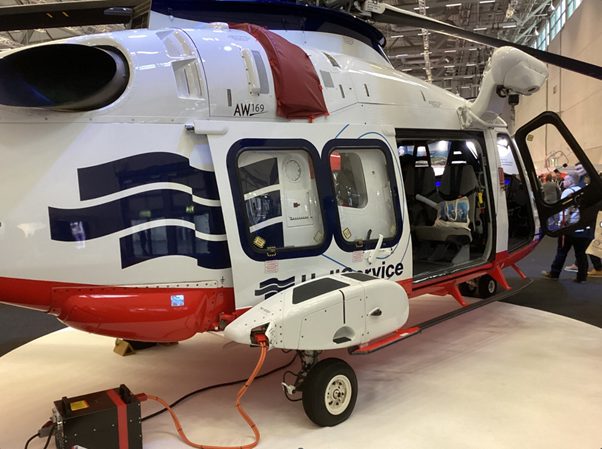
Leonardo's AW169 at European Rotors - AKA the Interview Room.
Seldom do we mention the space in which our interviews take place. But it’s worth making an exception for the latest conversation with Giacomo Zampetti, vice president, Marketing, Leonardo Helicopters. We are sitting in the roomy interior of a red and white AW169 at the European Rotors show in Cologne, Germany.
Roomy because the medium-size, twin-engine helicopter, wearing the colours of offshore and EMS operator HeliService, can accommodate up to 10 passengers. Or two stretchers and five medical attendants in addition to two pilots.
Zampetti is clearly in buoyant mood – Leonardo Helicopters is having a good show. During the event, the manufacturer revealed it has signed a new contract with training and SAR operator Heli Operations for two additional AW139s bringing its total fleet to six aircraft. Also, Offshore Helicopter Services UK is expanding its AW139 fleet with the order of two additional helicopters to be delivered by the end of this year.
‘A central workhorse’
“The AW139 remains a central workhorse for energy, pax transport and SAR and even natural disaster support,” Zampetti told us amid the show hubbub. “Our expansion with Heli Operations underscores continuing confidence in the type.” Together with the AW189, both aircraft play a growing role in supporting energy operations in a market where bigger types like the Sikorsky S-92 used to be the reference point, he adds. Also, UK charter company Thunder Aviation agreed to acquire three AW109 Trekkers.
But it’s not just about selling helicopters. Highlighting the importance of its growing helicopter fleet in Norway, Leonardo is introducing a new AW189 Level D Full Flight Simulator in the coastal town of Sola and strengthening local logistics and support in Oslo. This includes on-site Leonardo technical personnel and an enhanced spares pool availability deployed by local aviation services firm Norwegian Aero Solutions.
It’s further evidence the manufacturer is reinforcing its strategy of providing full lifecycle support: from helicopter supply to maintenance, training and localised infrastructure. “With around 20 new AW139 and AW189 helicopters set to enter service in the coming years, Norway remains a strategic market for energy, SAR, public service and emergency missions,” said Zampetti.
‘Replace older platforms’
The oil and gas market is now “rebounding” after shrinking due to the oil price plunge combined with the ravages of Covid that disrupted (and continue to challenge) supply chains, according to the manufacturer. Two drivers are adding bounce to that rebound. “One is expansion due to the necessity of introducing modern equipment offering improved safety standards platforms,” Zampetti told us. “The other is the need to replace older platforms such as the S-92 type.”
That creates an opportunity to place super-mediums like the AW189. “The super-medium has had a lot of success in the previous years, specifically in the SAR market,” he said. “But now we see a lot of momentum for this platform in the offshore market – specifically in areas like North Europe, Gulf of Mexico and Brazil, where usually S-92 were operating.”
But however springy the rebound in oil and gas markets, Zampetti said powerful lessons have been learnt since the plunging oil price of 10 years ago. Since then, the industry has learnt to decouple the demand for helicopters from oil and gas values or, in other words, not to speculate production based on oil prices.
“There is much more educated equilibrium between demand and supply,” he told us. In addition to a growing industry reluctance to be exposed to oil price shocks, Leonardo is determined to differentiate helicopter assets as well as take into account a helicopter’s secondary mission life during the design stage.
“This has been a design philosophy that we’ve been using for some time in our Leonardo family range,” he said. “Designing flexibility into the platform is becoming more important – to have a very unobstructed cabin so that we can easily re-adapt and re-arrange the interiors to suit a secondary role.” That is becoming particularly important for large fleet operators, he added.
‘Critical trauma care’
Improving technology is also helping Leonardo to offer helicopters capable of delivering more sophisticated services. For example, some EMS helicopters now have the cabin size, medical equipment and power to stabilise patients on board during ‘the golden hour’ after trauma. It’s no longer a case of flying the injured to hospital as quickly as possible – helicopters have become flying medical centres. “The AW169 in which we are sitting today is a perfect example of such an aircraft.” said Zampetti. “It has the large cabin space needed to accommodate medical professionals and the equipment they need to offer critical trauma care.”
The AW169 power train transmission even has a clutch that enables the left engine to be effectively used as a dedicated APU allowing some aircraft systems and medical equipment to operate while the main rotor is stopped. This enables crews to deliver critical patient care on the ground, without the continuous low-frequency vibration arising from turning rotors.
A key part of flexible helicopter design has become planning aircraft capable of flying both civil and military missions. “We are trying to offer the same architecture for use in different markets,” Zampetti said. “This has been a specific investment strategy we’ve followed in recent years.” It’s a design philosophy that applies not just to larger aircraft, such as AW169s, AW139s and AW189s, but also to lighter helicopters such as the AW109 Trekker.
Here dual use means AW109s which have the ability to fly EMS and corporate missions together with military scout reconnaissance flights.
It’s a diversified strategy that is standing Leonardo Helicopters in good stead, said Zampetti. “The market is experiencing a good momentum in both civil and military markets – offering us a lot of opportunities.”
More news from European Rotors
- Milestone welcomes renewed stability in heli markets
- Bell 505 logs over 700 hours fuelled by blended SAF
- European Rotors reveals industry’s steady growth (and challenges)
HI Uplift Dashboard: Helicopters for sale
Multi engine
- Total for sale/lease: 271 – three fewer than last week
- Percentage for sale/lease: 3.55%
- Absorption rate: 3.59 months
- Total fleet: 7,628 – two more than last week.
Single engine
- Total for sale/lease: 436 – the same as last week
- Percentage for sale/lease: 3.73%
- Absorption rate: 3.74 months
- Total fleet: 11,689 – four fewer than last week.
Source: AMSTAT, December 5th 2025