HI Uplift: Sikorsky shows something old and something new
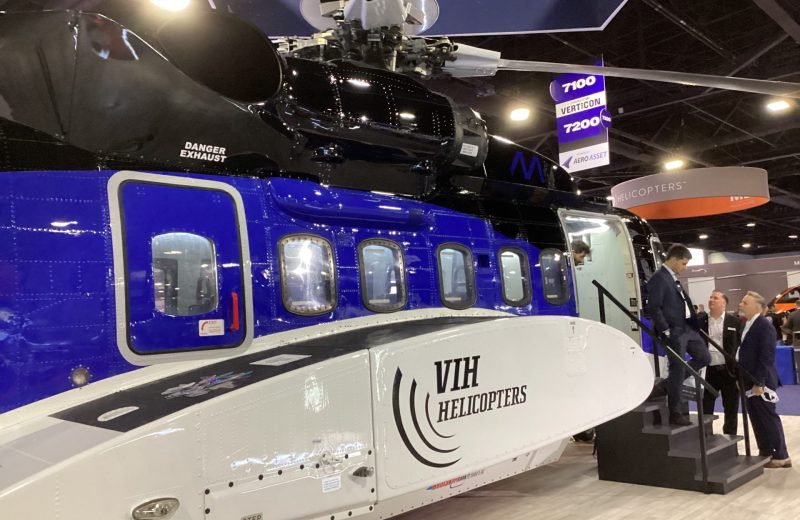
Something old and new: Sikorsky's oldest S-92 still in commercial service is enjoying new life as a firefighter.
“I think this aircraft is going to outlive us all.” Sikorsky’s Leon Silva is joking about the longevity of the manufacturer’s first Sikorsky S‑92 to enter commercial service in September 2004. We are sitting next to the venerable blue and white airframe – tail number 920006, now rejuvenated as a firefighter for VIH Helicopters – on Sikorsky’s stand at the Verticon show in Atlanta, Georgia. It’s a good place to start our conversation before moving onto the manufacturer’s investment in uncrewed aerial vehicles.
The sparkly clean, blue and white helicopter (pictured above) belies its long and varied history. So far, the aircraft has logged more than 15,600 flight hours; starting by supporting oil and gas missions in the Gulf of Mexico the same year Athens hosted the Summer Olympics. Since then, the historic S-92 has served with three operators across multiple jurisdictions, regions and mission profiles. Two years ago, the aircraft was reconfigured for firefighting duties and last year completed a firefighting season of more than 550 hours flying with operator VIH in Canada.
“The helicopter is in fantastic shape and still has a lot of working life ahead,” says Sliva, vice president of Global Commercial and Advanced Programs at Sikorsky. S-92 airframes are rated to fly 30,000 hours, so the helicopter next to us can look forward to another 14,400 hours – or more than 28 years at 500 hours a year.
But, perhaps, not offshore hours. The average age of the offshore fleet is about 10 to 12 years and with some contracts precluding helicopters older than 20 years. Nevertheless, a wealth of shore-based missions remain – not least the growing global demand for firefighting assets.
‘30,000-hour limit’
“We see tons of opportunities for these aircraft in the long term and very few retirements,” Silva tells us. “There have been just two retirements of S-92 aircraft, specifically due to the 30,000-hour limit on the airframe.”
Back to the aircraft standing next to us, VIH Helicopters, based in British Colombia is operating the S-92 under lease from Milestone. The Canadian operator’s president Ken Norie was fulsome in his praise of the older airframe. “Its performance and mission adaptability enabled a seamless transition into the Fire Raptor configuration and supported a highly successful and demanding firefighting season,” said Norie in a statement. “The ongoing support provided by Sikorsky has been critical to sustaining exceptional serviceability and ensuring the aircraft consistently delivers top-tier performance.”
About 73% of the S-92 fleet can still look forward to a significant working life ahead, according to Sikorsky. Silva puts it like this: “If we take the full fleet that is installed and active, which is about 260 – 270 aircraft, if you look at the remaining life of those aircraft up to the 30,000-hour limit, we are only about 27% penetrated. So, there is plenty of life left in the existing fleet,” he says.
Plus, more sparkly new S-92s are soon to roll of new production lines with the Sikorsky’s commitment to boost production of its new S-92A+ aircraft with a plan to build five aircraft this year before ramping up to building 12 airframes annually in following years. The new variant features additional engine power from its GE CT7-8A6 engines, which are said to maintain power through greater temperature ranges in hot and high-altitude environments. Deliveries are expected to start in 2028.
$100m budget
The S-92A+ is also equipped with the Phase IV main gearbox, developed with a $100m budget, which is in its final 200 hours of endurance testing. The new gearbox will have a minimum operating lifecycle of 6,000-plus flight hours, designed to ensure longer intervals between overhauls. The gearbox features auxiliary lubrication so the helicopter can complete a flight safely even if primary oil pressure is lost. The S-92A+ is available as a kit for retrofit to any S-92A aircraft with the option for upgraded engines.
A 14th country recently ordered two aircraft for head-of-state transport, which will be built this year the manufacturer confirmed. Over the medium to longer term, it estimates the market for the new S-92A+, and older aircraft retrofitted with the S-92A+ upgrade kit, to be more than 80 airframes.
Silva describes the decision to launch the S-92A+ as “mostly market-driven” and places it within the context of recent history. “We had a few years during which we had extreme challenges with the supply chain. So, we focused on the support of the installed fleet and continued to build two or three a year – mostly for heads of state around the world. To give you an idea, about 85% of our team was focused on the aftermarket.” (Perhaps, unsurprising bearing in mind each individual S-92 is equipped with about 40,000 parts).
Supply chain
But that perspective shifted with improved stability on the supply chain combined with the market interest in heavy lift – both persuading the manufacturer that now is the right time to rescale production. S-92A+s deployed on search and rescue (SAR) missions are considered a particularly promising area of the market, driven by the growth in government contracts.
One example is the South Korea Coast Guard, which continues to buy S-92s. In fact, the OEM is preparing client proposals for offshore configured aircraft for the first time in 10-12 years.
So, bearing in mind the longevity of the S-92 platform, when can we look forward to the launch of the S-92A++? Silva smiles: “There are no discussions on that. We’ll see how the A-plus goes.”
On to firmer ground with the Sikorsky Nomad 100 uncrewed VTOL aircraft, featuring in glossy videos on the manufacturer’s stand. The Nomad 100 is an unmanned aerial system (UAS) designed to bridge the gap between smaller reconnaissance drones and larger, fixed-wing assets. Equipped with an 18ft wingspan, designed for long endurance, the tail-sitting aircraft takes off vertically like a helicopter before transitioning to horizontal flight.
Nomad 100’s role
Designed for both military and civil applications, the manufacturer sees Nomad 100’s role as complementing helicopters on SAR missions and land vehicles on utility flights. Igor Cherepinsky, director of Sikorsky Innovations describes its role to us like this: “We see the crewed-uncrewed teaming aspect across all industries – from search and rescue to powerline inspections and other missions. You’ve got the uncrewed aircraft out front, sensing the target [on SAR missions] being that loyal wingman for the crewed aircraft that’s following.”
From new designs back to old aircraft. Returning to the topic of S-92 helicopter retirements, Silva confirms the third S-92 helicopter is projected to retire in 2032. It’s a date that puts him in mind of another retirement. “Co-incidentally, 2032 is also the date I am thinking of retiring. So, the next S-92 and I will retire together,” he jokes.
HI Uplift Dashboard: Helicopters for sale
Multi engine
- Total for sale/lease: 244 – one more than last week
- Percentage for sale/lease: 2.34%
- Absorption rate: 3.34 months
- Total fleet: 10,348 – one fewer than last week.
Single engine
- Total for sale/lease: 409 – one more than last week
- Percentage for sale/lease: 2.99%
- Absorption rate: 3.79 months
- Total fleet: 13,665 – one more than last week,
Enjoyed this? Subscribe to our free weekly newsletter focusing on the key helicopter stories in the market.