HI Uplift: Milestone learns from past at Helicopter Investor London
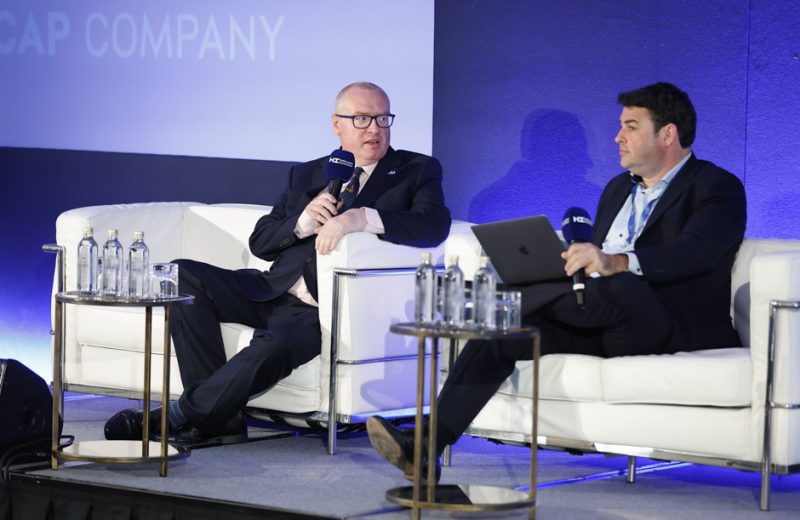
Milestone CEO Pat Sheedy (left) pictured in conversation with Alasdair Whyte.
Last Wednesday proved a busy day for Milestone Aviation Group. Not only did the lessor reveal it had signed a five-year lease extension with South Korean operator HeliKorea for a Leonardo AW169. Also, Milestone’s CEO Pat Sheedy welcomed stability returning to the sector in the opening session of our Helicopter Investor London 2025 conference.
Speaking in the company’s 15th anniversary year, Sheedy said: “Stability is a good word in that the volatility we saw over the past decade – with orders all over the place and the exuberance that all of us were involved in – really crashed down on the sector. We don’t need that type of exuberance again. So, we’ll take stability for the moment.”
Ensuring that stability endures depends on learning the lessons of the past to avoid repeating its mistakes. What triggered past problems were not mistakes by financiers or over production by the OEMs. “It was driven by a geopolitical shock, which was an oil price, which itself was driven by a price war between salaries and share,” he said. One of the biggest lessons of the past downturn is to challenge the assumptions that helped to give rise to it.
‘What the industry should promise’
“Collectively, as an industry, if you go back to 2014 and 2015, we assumed that there was going to be annual growth in natural gas [production] of between 4% and 10%, with 4% being the bear case and 10% being the bull case. There was no assumption that it was going to be negative. And I think that assumption then fell into our model in terms of what our people required, what the OEM should build, what we should order, what the industry should promise,” explained Sheedy.
Another wrong assumption was that although exploration would dry up, leading to a reduction in demand, assets serving production platforms were going to stay in place. “From my perspective, the big lesson is let’s be careful about our assumptions,” he said. “Because when we get them wrong, it doesn’t just impact Milestone or one of the OEMs, it impacts the entire industry.”
Even today, there is still an embedded assumption that there is going to be strong demand for what the CEO termed “motor racing capacity growth”. There’s no reason to assume that demand for new helicopters will continue to grow by 5% to 9% each year. “We’re not going to fall into the trap we’ve played historically in terms of what we supply and demand,” said Sheedy.
‘Transition is coming’
But it is true that from next year, significant numbers of Sikorsky S-92s are scheduled to reach the end of their primary working life and require replacement. “We know that transition is coming, that super-medium [helicopter] transition is coming,” he said. “During the past five months we’re probably the largest buyer of super-medium aircraft. We’re going to be part of it. We’re going to be part of managing that transition.”
For example, Milestone revealed in January that it had won the contract for the purchase and leaseback of five new Leonardo AW189 helicopters with Equinor Energy – the largest oil and gas operator on the Norwegian Continental Shelf. The aircraft are scheduled to deliver between this year and next for deployment on offshore North Sea missions.
Speaking at the time, Sebastien Moulin, chief commercial officer, Milestone told us: “This was a significant tender, with multiple aircraft and complicated logistics to be addressed. It was one of the largest tenders, certainly in recent times, to be taken to the market, with a formal tendering process to be followed.”
Nevertheless, Milestone remains the biggest owner of S-92s. And drawing assumptions based on the fleet’s project retirement is fraught with difficulty. “It‘s very, very difficult to say when those transitions [to super mediums] will happen,” said Sheedy. “And if you’re assuming 10-, 20-odd plus S-92s are going to just disappear from 2027 onwards and be replaced by super-mediums, and they don’t, that’s a lack of capacity. We would be very close to slipping back into a long-term supply market [problems] if you get that assumption is incorrect.”
Significant growth
Asked to identify hot spots and markets, Sheedy highlighted Brazil as an area showing significant growth “as opposed to just swapping types or swapping operators or swapping helicopters”. More mature markets of the North Sea, Norway, Australia were showing a lot of activity, but not a lot of growth. But, in general, he welcomed stable demand across all countries and all helicopter types.
While revenue generated from offshore oil and gas remains a key income stream, the lessor is also working to boost income from its utility missions such as emergency medical services missions (EMS) and fire-fighting flights. Which brings us back to the AW169 deal revealed last Wednesday.
The five-year contract extension will see the light intermediate, twin-engine helicopter, originally delivered to HeliKorea in December 2016, continue to fly EMS flights in the country. All part of the lessor’s plan to diversify its portfolio through investment in mission critical sectors such as EMS.
Sheedy summed up what he would like to see from the helicopter market in 2025 like this: “I think boringly stability is the take-away.”
Watch out for more reports and video snippets from Helicopter London 2025 over the coming weeks. If you enjoyed reading this content and think colleagues would too, please email them this link to sign up for our free newsletter.
Helicopter Investor News
- Air Methods hails launch of new Florida base
- Wisk to take SkyGrid under wing as pair work closely on autonomy
- Helicopter Investor Deal of the Year 2025 Awards winners revealed
- Aerius and AL Group forge new leasing partnership
- GDHF firms 10 H175 orders, brings order book to 20 aircraft
- HI Uplift: Lift-off for our London 2025 conference
HI Uplift Dashboard: Helicopters for sale
Multi engine
- Total for sale/lease: 278
- Percentage for sale/lease: 3.71
- Absorption rate: 3.89 months
- Total fleet: 7,489.
Single engine
- Total for sale/lease: 435
- Percentage for sale/lease: 3.76
- Absorption rate: 3.84 months
- Total fleet: 11,580.
Source: Amstat, June 13th, 2025.