HI Uplift: HEMS growth but contract challenges
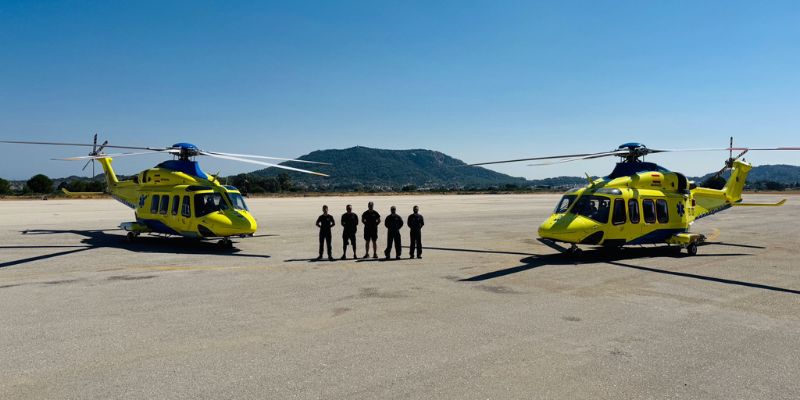
Avincis made two AW139 HEMS helicopters operational in Greece in July.
The good news is growth. The not-so-good news is increasing contractual challenges. That’s the helicopter view of the helicopter emergency medical services (HEMS) market from two leading industry insiders at our Finance Forum at European Rotors.
Supplying the market analysis was the author of a new report on the topic Sara Dhariwal, principal aviation analyst and lead appraiser – Helicopters & AAM, Cirium Ascend Consultancy. Delivering operational insights was Simon Tye, group chief commercial officer from Avincis.
Fresh from writing her latest report – EMS: From Growth to Renewal, Navigating the Next Decade – Dhariwal noted that the global EMS fleet has grown steadily at about 2.5% per year for the past three years. North America is home to the biggest EMS helicopter fleet, with nearly 1,400 aircraft configured for emergency missions, accounting for about 50% of the global total. Europe ranks second, operating about 800 helicopters, which represents nearly 30% of the global fleet.
“This expansion has been partly enabled by lessors – of the approximately 560 helicopters added since 2015, 45% were leased aircraft. The leased share of the total EMS fleet is now at 14%, increased from 3% a decade ago,” noted Dhariwal.
Leased fleet
Growth in the leased fleet share was likely to be driven by lessors seeking to diversify portfolios that had been exposed to the volatility of the oil and gas market. Another driver is growing demand for larger, more complex helicopter configurations, which lessors have helped to make more accessible through leasing arrangements.
It’s a transition reflecting the greater stability and long-term nature of EMS contracts, specifying specialised aircraft configurations, often tailored for compatibility with hospital equipment, compared with those on offer in the offshore sector. Such specialism makes transferring leased helicopters between operators more costly that transfers between other mission types.
Funding models vary between privately-owned hospitals, particularly in the US, charity-funded operations, common in the UK, publicly funded, non-profit organisations and insurance and roadside assistance organisations, such as those in Germany.
EMS contracts
While EMS contracts can be more stable and longer lasting than some offshore deals, they are also more complex and that complexity is growing, according to Tye from EMS operator Avincis, In addition to HEMs, the business also specialises in firefighting, search and rescue and offshore energy missions.
“From an operator’s perspective, the market is very busy and we’ve seen a convergence of vendors within the market,” Tye told the forum. “There’s a bit of growth, but the biggest thing we’re seeing is the need for clients in certain jurisdictions to consider the complexity of operations especially when building their tender requirements as part of a procurement process. If key elements are missed then safety could be compromised and costs could increase.”
Clients are asking for ever more complex HEMS operations. But sometimes the budgets don’t match for the operational requirements they are asking for. “We are trying to find a way through that to make sure that we can retain our market share and keep delivering a safe and value-for-money service to our customers,,” he said. Tye also referenced the recent Leonardo HEMS conference which discussed the commercial pressures of HEMS operations compared with safety priorities within the market.
‘Difficult to work within’
Unpicking the challenges of HEMS contracts, Tye highlighted contracts’ fixed terms and their income generating potential. For example, in Spain and Portugal, HEMS contracts generally last five years with a fixed budget. “While not impossible, these terms can be difficult to work within, especially given the amount of risk that the operator is carrying in making sure that the pricing structure is correct,” said Tye.
Unlike government-funded search and rescue programmes, HEMS missions in Europe are more typically funded by local states or healthcare providers that fund the projects, he added. Such organisations don’t always assign the suitable budget for the aviation part of their service as they are often combined with other healthcare spend.
“Our part is to be transparent with them,” he said. “We have to explain if you want this kind of service – which now generally involves 24-hour operations with a lot more clients asking for hoisting operations and NVIS [Night Vision Imaging System] provision – that comes with a price tag, and the budget doesn’t generally match that.”
The years ahead
So, how are we likely to see the EMS market evolve in the years ahead? The key markets for Avincis are in Iberia, Italy and Sweden with a fixed wing operation in Norway, said Tye. “We have a substantial market share in these jurisdictions. Plus, there are growth areas we’re looking at in Greece and other places where we see potential,” he added. “
By contrast, the mature markets of Germany, France, the UK have limited growth prospects. Spain too is a stable market but there are pockets of regional growth in the country, said Tye. But some Eastern European countries – such as the Czech Republic – look like showing promising growth.
Dhariwal, at Cirium, predicts the market is consolidating. “We’ve seen growth of 2.5% slowing a little bit lately,” she said. “Hence the thesis that we’re now moving into a more mature market where the opportunity is more renewal [in fleet replacements] rather than growth [in incremental demand for new helicopters].”
Twin engine types
Growth will moderate to just over 1.5% annually, with driven mainly by Asia, according to the Cirium Fleet Analyzer. About 30% of the existing fleet – mainly focused in Europe, which favours twin-engine helicopter, and North America, where single-engine aircraft are more common – will require replacement. Cirium expects new deliveries to focus on twin-engine types rather than single-engine with new models, such as the Airbus H140, likely to stimulate demand. (Although, David Smith, CEO of the Robinson Helicopter Company told us at European Rotors that the company’s new single-engine R88 helicopter was designed specifically with the HEMS market in Europe and America in mind.
Meanwhile, Dhariwal concluded: “Success over the next decade is likely to focus on operational resilience and strategic positioning in a market where replacement, not growth, defines the opportunity.” You can read Cirum’s latest EMS report here.
HI Uplift Dashboard: Helicopters for sale
Multi engine
- Total for sale/lease: 272 – one more than last week
- Percentage for sale/lease: 3.56%
- Absorption rate: 3.57 months
- Total fleet: 7,631 – three more than last week
Single engine
- Total for sale/lease: 439 – three more than last week
- Percentage for sale/lease: 3.75%
- Absorption rate: 3.76 months
- Total fleet: 11,693 – four more than last week.
Source: AMSTAT, December 12th 2025