Robinson Helicopter Company plans big year for R88
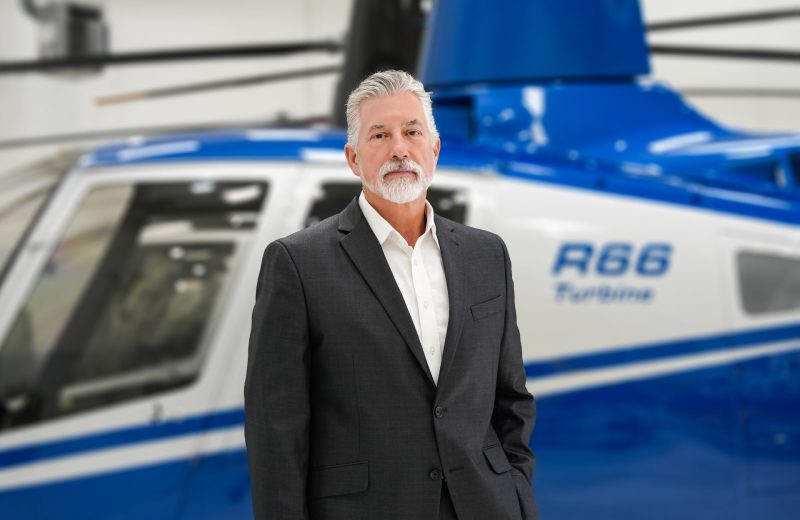
Robinson's Glenn Ford is on a mission to gear up factory production for the new R88 and other rotorcraft.
2026 is lining up to be a big year for Robinson’s new R88 helicopter. After its show debuts last year at VAI’s Verticon in Dallas and European Rotors in Cologne, 2026 will see the aircraft’s maiden flight.
Glenn Ford, the OEM’s chief operations officer explains its significance to us: “The R88 opens Robinson to both expand existing markets and enter new mission sets, including EMS [emergency medical services], firefighting, external lift, large utility, tourism and corporate transport”.
“The aircraft delivers capability at a cost point that is highly competitive in today’s market. It enables us to attract new operators while giving existing customers a larger, more versatile Robinson platform that preserves our reputation for reliability and low operating cost.”
It will also be a big year for Ford himself. An industry veteran backed by four decades of industry experience, Ford joined Robinson Helicopter Company (RHC) in October 2025. His packed resume includes wide experience across the aerospace industry in manufacturing operations, engineering design and supply chain logistics. (He has held leadership roles at major industry organisations, including Sikorsky, Pratt & Whitney, and ICON Aircraft).
‘Strengthening supply chains’
This experience will help Ford prepare the factory for optimal production as it gears up to produce the R88 helicopter and the other aircraft in the OEM’s range. “My background is leading operational transformation by setting a clear vision, defining a plan, and executing it,” says Ford. “I have stood up factories, scaled production, strengthened supply chains, and improved quality and cost performance across multiple aerospace and advanced manufacturing environments.”
A key focus of his leadership has been cost control and cost transparency, he says. “This part of my mission is designed to ensure we invest where it matters, eliminate waste, and protect margin without compromising safety or quality. By applying these disciplines at Robinson, we ensure our legacy programmes remain cost-competitive while the R88 launches with a strong financial foundation.”
Ford’s mission at RHC is to boost manufacturing capacity and efficiency. Ford is overseeing operational strategies designed to increase production capacity, efficiency and logistics optimisation. Ford is also supporting the development of new production lines for the recent R88 helicopter and the Spirit, Spartan, and Helius coaxial unmanned helicopters.
David Smith, president and CEO of Robinson Helicopter Company, speaking after Ford’s appointment said: “Ultimately, this isn’t just about internal improvements; Glenn’s expertise is directly connected to our customers. By implementing smarter production and maintenance, repair, and operations [MRO] strategies, we will significantly increase our speed to market and responsiveness. This will ensure that our customers receive the quality aircraft and parts they depend on, faster than ever before.”
Despite continuing supply chain challenges, Robinson believes the supply chain is improving, but unevenly. “Lead times are stabilising for some components, while powerplants, specialty materials, and avionics remain constrained,” says Ford. “We are mitigating risk through long-term supplier agreements and multi-sourcing. Strong supplier partnerships are a force multiplier for our success.”
‘Tighter control of quality’
When the external supply chain can’t support demand, Robinson relies on its vertical integration model. The company designs, engineers and manufactures most of the aircraft in-house. “This gives us tighter control of quality, cost, and schedule, ensuring we meet our production commitments without compromise,” he adds.
Five months into his not-so-new role, Ford explains to Helicopter Investor his long to do list: “We are modernising factory operations with improved production control, increased material velocity, and digital work instructions integrated through a clean ERP [enterprise resource planning] backbone. This provides real-time visibility to production status and inventory accuracy. In MRO, we are increasing spare parts availability, reducing turnaround time, and advancing toward predictive maintenance, ultimately reducing waste, shortening lead times, and increasing aircraft availability for operators.
Throughout the modernisation, Ford keeps two things in mind. “Our capacity expansion supports two priorities: scaling for the R88 and increasing output of our R22, R44, and R66 product lines. Demand remains strong across aircraft and spare parts sales, and expanding capacity shortens lead times, increases production rate and improves delivery performance and customer experience.”
Big boost
Which brings us back to then new R88 helicopter. The new aircraft is a big boost in size for the Robinson range. Designed for 10 occupants – two in the cockpit and eight in the main cabin – the helicopter has a volume of 275 cu. ft, a payload of over 2,800 lbs. and full-fuel payload of over 1,800 lbs and a maximum cruise speed of 130 knots. Power is supplied by a single 950-shaft horsepower Safran Arriel 2W engine.
The cockpit features a Garmin G500H TXi glass-panel flight deck with 4-axis autopilot, dual hydraulics, and dual cyclic controls—a configuration that supports optional single-pilot IFR operations when specifically equipped. Additional optional equipment includes: high skids, 3,000-lb capacity cargo hook (HEC-rated), firefighting water tank and pop-out floats.
Price depends on specification and equipment but starting price is expected to be about $3.3m.
So, a progress report on the aircraft’s development please? “The R88 programme is progressing as planned,” Ford tells us. “The first-flight aircraft is currently in build, with subsystem testing and validation underway, as well as all major suppliers aligned on long-lead materials. We continue to target the end of 2026 for first flight.”