Skyryse introducing first-ever autoland capability for helicopters
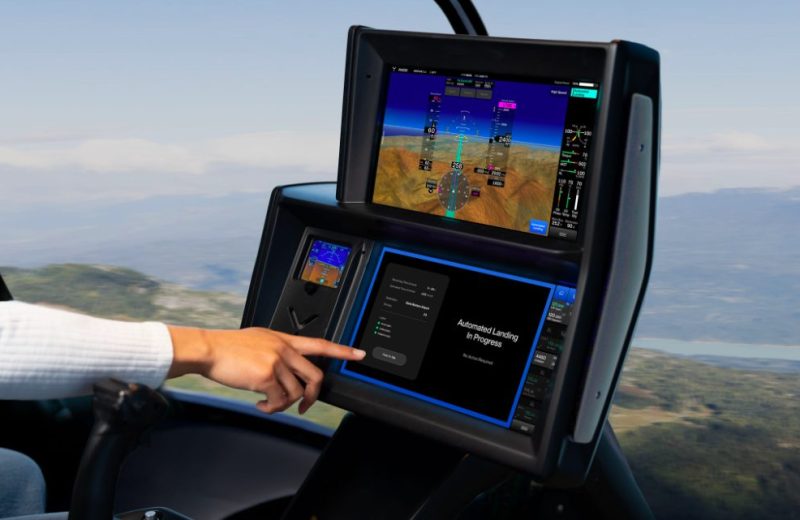
Aviation automation specialist Skyryse has unveiled plans to introduce an emergency autoland capability for both helicopters and airplanes.
The feature will be integrated within SkyOS, the company’s in-house developed software-based flight control system.
With the “swipe of a finger” any aircraft will be able to execute a safe emergency landing sequence, stated the company in a press release. The feature does this by using a triply redundant fly-by-wire architecture that includes human-machine interface, an advanced sensor fusion suite and software-defined flight control laws.
“By creating a holistic software-hardware solution like SkyOS, we’re able to develop and integrate lifesaving features like emergency autoland at unprecedented speed,” said founder and CEO Mark Groden. “When we started the company, we focused on flight automation in helicopters first because that is the hardest engineering challenge to solve. Every other aircraft is a subset of those requirements.”
Skyryse expects the autoland feature to support use cases such as pilot incapacitation, spatial disorientation and severe weather encounters.
Development and certification for integration into helicopters will follow certification of Skyryse One, the company’s helicopter in development based on the Robinson R66.
Groden said: “Helicopters operate in environments where pilot workload is extremely high, and margins are often razor-thin, and that’s why we’re especially proud to take the 10 years of development and testing we’ve put into SkyOS to date, and continue to add features and capabilities that the aviation industry needs most. SkyOS allows us to treat airplanes and helicopters as software-defined vehicles, enabling levels of automation that simply weren’t practical with legacy systems.”
How it works
By autonomously managing the entire landing sequence in emergency situations, SkyOS’ emergency autoland will maintain a stable aircraft profile, navigate to a suitable landing site, manage energy and safely perform approach and touchdown.
Unlike legacy autoland systems, which are currently confined to airplanes and typically limited to specific models, Skyryse’s approach treats emergency autoland as a core SkyOS function. This allows for “deterministic performance” and “scalable deployment” across multiple aircraft categories, stated a press release.
When engaged, either by pilots or passengers, SkyOS’ emergency autoland monitors aircraft altitude, speed, trajectory and envelope limits. Then, while managing power, SkyOS autonomously executes a controlled approach and landing appropriate to the environment.
Skyryse said its emergency autoland capability will build on existing SkyOS features, including inherent stability and simplified flight controls, as well as dynamic envelope protection, including terrain awareness and obstacle detection and fuel monitoring and weather assessment.
The payoff
For helicopters autoland represents a significant safety upgrade. Helicopter operations routinely involve low-altitude flight, confined landing areas, high pilot workload and complex energy management, especially during emergencies. Historically, these factors have made automated landing solutions for helicopters extremely difficult to deploy. Skyryse’s emergency autoland continues the company’s track record in pioneering automated aviation technology, including having successfully automated engine-out landing. Also known as an autorotation, this is one of the most complicated emergency scenarios to navigate in a helicopter.