HI Uplift: New $50m helicopter training hub planned for UAE
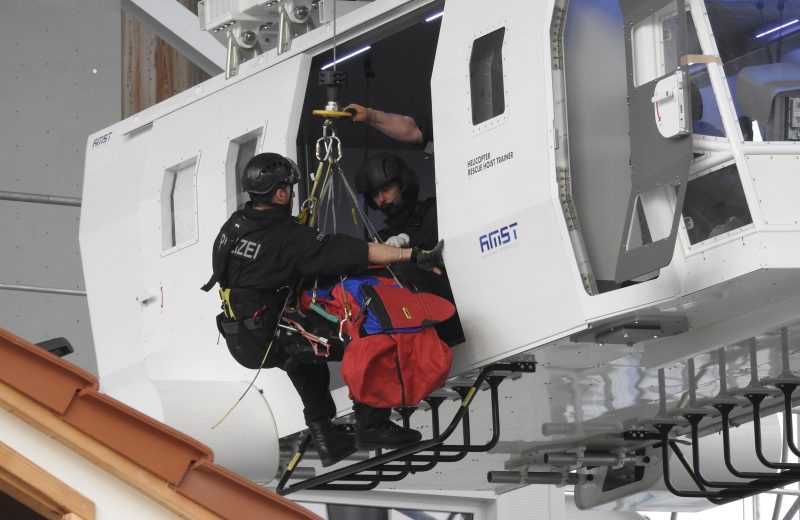
The new helicopter training hub aims to simulate harsh real-world conditions.
A new $50m helicopter rescue training centre in the United Arab Emirates (UAE) is scheduled to open in 2028. The centre will serve as a regional hub for advanced, certified mission-based training for Helicopter Emergency Medical Services (HEMS), commercial enterprises, law enforcement and special forces worldwide.
“What sets the centre apart is the ability to bring multiple high-risk training environments together in one place,” Jamal Alkaf, CEO, Sahra Group tells Helicopter Investor. Developed in partnership with AMST Group, Sahra Group says the Security & Rescue Training Centre will be the first commercial facility to offer helicopter rescue simulation with maritime, disaster response and industrial training environments.
“It combines advanced helicopter rescue simulation with maritime, offshore and tactical training capabilities – something that isn’t currently available in a single commercial facility,” says Alkaf. “Teams can train across helicopter hoist operations, fast roping and rappelling, helicopter underwater egress training [HUET] and water rescue and maritime operations. All conducted within a fully controlled environment, allowing them to safely replicate complex missions that would be difficult, costly or unsafe to conduct live.”
Disaster response
Training at the centre will also include disaster response and mass-casualty scenarios plus industrial missions across energy and infrastructure sectors.
Both Sahra and AMST Group believe current global conflicts will lead to further offshore oil and gas exploration and development, as nations prioritise energy security. “Energy security is firmly back at the top of the agenda, and offshore oil and gas remains a critical part of that mix,” Alkaf tells us. “While the transition to renewables is accelerating, we’re seeing continued investment in offshore exploration and production as countries look to secure stable, domestic or regional energy supplies.”
Operational demands are increasing across rescue, offshore and security missions, but live training alone can’t keep pace, according to the development partners. Plus, advanced simulation technology now allows crews to train for more scenarios, more often, and in a fully controlled environment. “That shift is driving a new approach to readiness. This facility is built for that moment,” says Alkaf.
A broad range of operators are expected to send their staff for training in mission-critical and emergency response activities. Included in the list of prospective clients are: helicopter emergency medical services organisations, search and rescue teams, coast guards, police, fire and civil defence, as well as military and special forces units.
Offshore oil and gas
Sahra also expects strong demand from commercial sectors such as offshore oil and gas, energy and infrastructure, where helicopter and water-based operations are a core part of day-to-day operations.
The new facility will feature crane-suspended helicopter simulators and immersive environments that replicate real-world conditions. Those include replicating conditions of low visibility, high noise and rotor downwash enabling teams to train for complex, high-risk scenarios in a safe and controlled setting.
When fully operational, the hub will have the capacity to train up to 4,500 personnel annually and reflects a growing shift toward synthetic training to improve readiness across both public safety and defence sectors. “Helicopters are involved in more than 1,000 rescues each year,” says Alkaf. “But traditional helicopter-based training is costly, weather-dependent and resource-intensive, while simulation enables significantly greater training frequency at a fraction of the cost.” Synthetic training is said to enable aircrew to gather 10 times the experience in simulation compared to live helicopter training.
Wolfgang Lindlbauer, senior business development manager at AMST Group said: “In every rescue, operation or critical response, the margin for error is measured in seconds – and in lives. This new facility will eliminate uncertainty by recreating the most demanding real-world conditions in a controlled, repeatable environment.”
Hazardous scenarios
The new safety training hub will enable crews to master intense and hazardous scenarios, while building instinct, precision and the confidence to perform at a top level during operations, he added. “By combining advanced simulation with mission-based training, we are making world-class preparation safer, more accessible and more cost-effective, ensuring that every crew member, responder and operator is equipped to perform when it matters most.”
So, how will the partners measure the success of the new training hub? “Success will ultimately be measured by impact – how effectively we improve operational readiness across the sectors we serve,” says Alkaf. “From day one, the facility has the capacity to train up to 4,500 personnel annually across emergency services, defence and commercial operators.”
The organisers will also look for metrics beyond mere volume. “We’ll be looking at how often organisations return for repeat training, how we expand partnerships internationally,” says Alkaf from Sahra. “And how the centre becomes a recognised benchmark for high-quality, mission-critical training in the region.”
It looks like the partners won’t have to wait long to gauge the success of their new safety training hub.
HI Uplift Dashboard: Helicopters for sale
Multi engine
- Total for sale/lease: 244 – four fewer than last week
- Percentage for sale/lease: 2.36%
- Absorption rate: 3.08 months
- Total fleet: 10,345 – three fewer than last week.
Single engine
- Total for sale/lease: 404 – Five fewer than last week
- Percentage for sale/lease: 2.96%
- Absorption rate: 3.64 months
- Total fleet: 13,658 – two more than last week.
Source: AMSTAT, April 17th, 2026