HI Uplift: Grappling with ‘the worst energy crisis for 25 years’
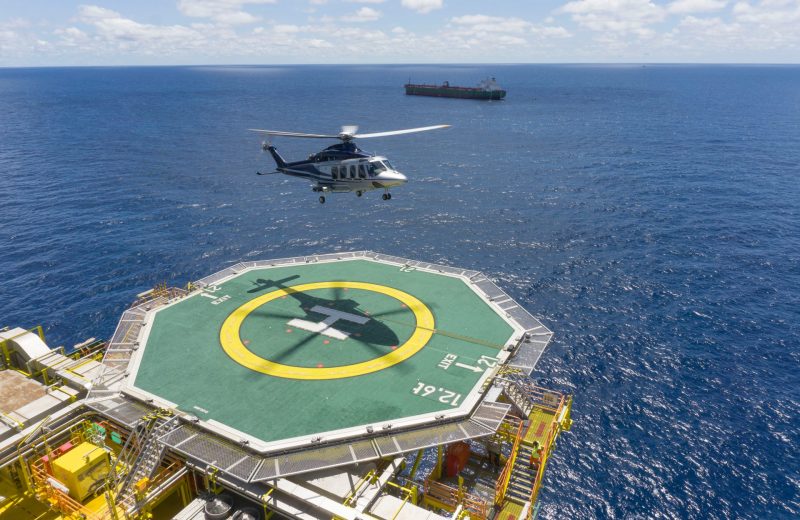
The current conflict is reshaping the global energy order, says Steve Robertson.
“What’s happening in the Gulf is delivering the biggest shock to energy prices over the past 25 years.” That was the stark assessment of Steve Robertson, from Air & Sea Analytics, shared with Helicopter Investor at last month’s Verticon event in Atlanta, Georgia. Nearly a month later his report, Global Energy Shock & Rotorcraft Market Impact, details how the war is likely to shape global energy markets and the helicopter industry that serves them.
The report begins by quoting the International Energy Agency’s judgement, which goes even further. The US-Israeli military operation against Iran, launched on February 28th, has triggered the “largest supply disruption in the history of the global oil market,” it said.
The subsequent closure of the Strait of Hormuz places in jeopardy about 20% of global oil and 20% of the world’s liquid natural gas that move (or used to move) through the critical passage of water every day. “Brent crude has surged above $100/bbl from a pre-war [level of about] $67, global oil supply has been reduced by an estimated 11 million barrels per day net of mitigation measures, sovereign governments are implementing wartime-style fuel rationing, and critical downstream industries – from fertilisers to petrochemicals to aviation – face supply chain fractures that will take years to fully repair,” according to the report.
‘Demand collapse’
In addition to the human tragedy unfolding in the Gulf and beyond, the conflict is having a devasting impact on the helicopter market in the Gulf Cooperation Council (GCC) region. As one of the world’s most concentrated offshore aviation markets the GCC civil helicopter sector was also likely to be particularly vulnerable. “The conflict has effectively shut down routine offshore helicopter operations across much of the GCC,” notes Robertson’s report. “Demand collapse: With platforms de-manned and production suspended across Saudi Arabia, UAE, Kuwait and Qatar, crew transfer flying – the core revenue base for Gulf helicopter operators – has ceased or been sharply reduced to emergency-only operations.”
The main drivers of demand in the region are offshore oil and gas crew transfer operations and mega-project logistics under Vision 2030 and equivalent UAE programmes. Key operators include Abu Dhabi Aviation, Gulf Helicopters (Qatar) and Saudi-based Mukamalah.
Other impacts of the conflict include insurance repricing and supply chain disruption: “War-risk aviation premiums have escalated sharply, making non-essential operations prohibitively expensive even where airspace permits,” says the report. Also components, MRO resources and spare parts supply chains face delays and cost escalation.
Supporting evidence comes from geopolitical analyst Peter Zeihan who highlights that significant supplies of aluminium, key to aircraft manufacturing, are made in the Gulf region. Plus, a significant proportion of the world’s semiconductors transit the Strait of Hormuz.
‘Will not snap back’
Robertson predicts lasting consequences for the helicopter industry and global energy markets. “Even in an optimistic ceasefire scenario, the helicopter market faces a protracted recovery – production restart timelines for offshore fields are measured in months – crew transfer demand will not snap back.” Also insurance markets will carry elevated Gulf aviation risk pricing for years.
In addition international oil companies’ and national oil companies’ deferrals on Gulf upstream projects will suppress medium-term demand, writes Robertson. Plus, Vision 2030 and UAE development programmes may face funding constraints as sovereign wealth funds redirect capital to reconstruction
Robertson believes the conflict may accelerate the transition to unmanned systems. This is “evidenced by the UAE’s January 2026 order for 168 ANAVIA unmanned helicopters for military logistics and ISR [intelligence, surveillance and reconnaissance] signalling where capital is now being directed”.
The report also predicts an accelerating diversification away from Gulf dependency. This is likely to benefit US shale, Guyana, Brazil and West Africa as well as fast-tracking investment in renewables and nuclear.
“Strategic reserve policy will be comprehensively reviewed – the current system has bought time but exposed fundamental inadequacy for a disruption of this scale,” writes Robertson. “The energy security premium will be structurally repriced into sovereign planning and corporate strategy for a generation. The GCC’s diversification imperative – already urgent – becomes existential.”
The Air & Sea Analytics report also quotes Bloomberg from March 29th: if the Strait of Hormuz remains closed, the world must “significantly reduce its oil and gas consumption – but not before prices spike to a level that forces consumers and businesses to fly, drive and spend much less”.
Energy resilience
Other industry sources consulted by Helicopter Investor believe the war will highlight the transition from cheap energy to energy resilience and security. One manifestation of this could include more oil and gas exploration further from shore – perhaps underlining the requirement for heavy and super medium helicopters. Another could be renewed interest in generating electricity from offshore wind farms requiring the lift need to build and service such installations.
Today, the price of global benchmark Brent crude climbed above $111 (£84) a barrel in early trading before slipping to $109.
There’s no doubt the current supply shock matches or perhaps exceeds the impact of the 1973 Arab oil embargo. In an ever more inter-connected global economy, any disruption can have disproportionately large effects. But there’s one important difference, according to Robertson. “The 2026 Iran war has shattered the foundational assumption of modern energy markets – that the Strait of Hormuz, however threatened, would never actually close. It has. The economic consequences span crude oil, LNG, petrochemicals, fertilisers, food security, shipping and aviation.”
This leads him to conclude: “The question is no longer whether this conflict reshapes the global energy order. It is how profoundly, and for how long.” Read the analysis from Air & Sea Analytics here. Plus, Milestone’s take on rising oil prices here.
HI Uplift Dashboard: Helicopters for sale
Multi engine
- Total for sale/lease: 251 – one fewer than last week
- Percentage for sale/lease: 2.43%
- Absorption rate: 3.26 months
- Total fleet: 10,344 – four more than last week.
Single engine
- Total for sale/lease: 409 – three fewer than last week
- Percentage for sale/lease: 3.0%
- Absorption rate: 3.76 months
- Total fleet: 13,648 – one more than last week.
Source: AMSTAT, April 2nd, 2026.