HI Uplift: Milestone & SMFL Helicopters focus on growth
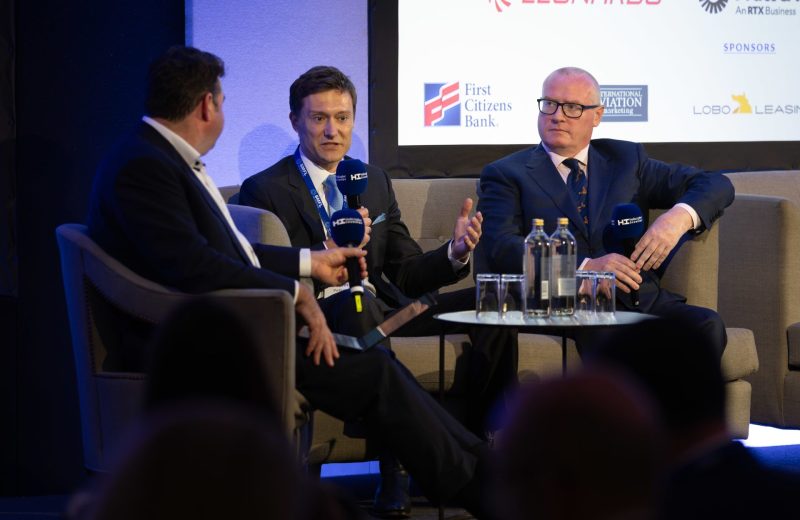
John Petkovic, SMFL Helicopters (second left) and Pat Sheedy, Milestone (right) in conversation with HI's Alasdair Whyte.
“From a Milestone perspective, this has probably been the first year since I’ve been with the company where we weren’t fighting [industry] fires.” That’s how Pat Sheedy, the lessor’s president and CEO summed up the first period of market stability in his 11-year tenure at the helicopter financing company. Joining Sheedy in the keynote session of our Helicopter Investor London 2026 conference was John Petkovic, CEO, SMFL Helicopters. Both agreed stability in the maturing market will bring new opportunities.
“When I sat here last year, I described my outlook on the industry as being boringly stable – I certainly got the ‘boringly’ part wrong,” explained Sheedy. “Since then, we’ve seen regime change in Venezuela, war in the Middle East and oil prices have fluctuated wildly. But even against that backdrop, it has been relatively stable in terms of the markets that we serve.”
That’s testimony to the robustness the maturing industry has developed in recent years, he added. “10 or 12 years ago, volatility like that would have caused chaos.”
Petkovic also welcomed market stability as he reflected on the launch of SMFL Helicopters in March and looked ahead. The lessor was created by Sumitomo Mitsui Finance and Leasing Company, Limited (SMFL) after it acquired and integrated leasing businesses previously operated by LCI and Macquarie Rotorcraft Limited.
Lift in secondary markets
“I’d describe it [the year] as one with potential. We’ve been talking about that for many years, but I think it really is starting to materialise.” Showing particular potential was the demand for lift in secondary markets after the primary life of helicopter assets, he said.
Petkovic praised what he termed “disciplined production” and “sensible innovation” among helicopter manufacturers. “OEMs are good partners right now,” he said. “They have been, for the most part, disciplined about who they’re selling to and what kind of fleets they’re putting out there.” But he did concede some cautious increase in production would be welcome.
“Pipeline is an issue,” said Petkovic. “Maybe some additional capacity or shifting some of it from military might help. But ultimately, it’s driven by end-user demand. I certainly wouldn’t want to just expand capacity for capacity’s sake. We’d like to see it in response to better demand from the end users so that it still maintains that discipline we’ve learned.”
Sheedy took a different view on the topic of OEM production discipline. “I don’t believe it’s their role to manage production discipline. My experience is the OEMs will sell to anyone who wants to buy. That’s their job,” he said. “I think it is up to the financing community and other participants in the industry, the operators themselves, to ensure that they’re not giving demand signals to the OEMs that truly don’t exist.”
‘The value they provide’
Petkovic welcomed consolidation at the lessor level, which has helped trading conditions while operators are now “starting to price at the value that they provide rather than the marginal cost of doing their service”. In summary: “It’s an industry that’s stabilised and has a lot of potential.”
Renewed stability offered Milestone the opportunity to implement plans that the lessor had kept on hold during the turbulent market conditions of recent years. “We have had a chance, as a management team, to step back and ask: what do we want to do with the business for the next five years? How do we need to manage the portfolio, which assets do we want to invest in?” said Sheedy.
“Part of that involved managing legacy aircraft and transiting some of those assets out [of the portfolio]. Having the breathing space to be able to do that was very important this year. At the same time, the team continues to deliver on the day job – placing 40 to 50 aircraft, or 100 transactions a year.”
Examples of new initiatives include developing a firefighting mission for Sikorsky S-92s after their primary mission in oil and gas ends and supporting a maintenance repair and overhaul facility to improve availability in Brazil.
Milestone has already helped VIH Helicopters in Canada rejuvenate S-92s into reconfigured firefighting platforms known as the Fire Raptor. Plus, last month the lessor revealed it had supported helicopter MRO Heli-One open a new S-92 customer support centre near Rio de Janeiro, Brazil with help from Sikorsky.
Contrary to expectations, the old S-92 workhorse is enjoying a new lease of life thanks to the reduced availability of new super-mediums and mediums as military demand dominates production lines. Also, Sikorsky’s investment in a new gearbox is helping to rejuvenate the platform – plus plans to build up to 12 new S-92A+ helicopters a year (albeit with heads of state accounting for their primary life).
‘Shift towards super mediums’
“We expected that, given the support issues the aircraft faced during 2024 and 2025, there would be a shift towards super mediums replacing S-92s. But that’s not happening. And the reality is the supply-demand balance here is very marginal,” said Sheedy.
He expected the wave of super-mediums replacing S-92s predicted to take place about now to be delayed until probably 2030, 2031.
Sheedy highlighted the difference between the economic life of an aircraft and its leasable life. “We look at being able to hold these aircraft for 20 to 25 years, generally 20 years in the primary mission, 10 years in the secondary mission, and then exit. The aircraft can do something else somewhere else but it’s not the market we want to play in.”
Petkovic agreed. “The only thing I would add is that you’re capable of making money in all different parts of the [aircraft] age profile,” he said. “We’ve seen LCI do it in the new space, we’ve seen MRL do it in midlife and end-of-life solutions, and we’ve played across that spectrum – I think it’s a relatively good bet. But no matter which part of that age profile you focus on, it really has to fit your broader strategic objectives and what you’re trying to do.”
‘Newest and shiniest’
Both executives praised the improving supply chain over recent years. “The message has got back that availability is key,” said Petkovic. “You don’t necessarily need the newest and shiniest piece of equipment. It’s really about parts on the shelf, keeping the aircraft flying and customer support. I think that message has been heard by them and they [manufacturers] have responded well.”
Meanwhile, both Petkovic and Sheedy have long to-do lists at their respective lessors. For Petkovic, growing the new business (combining LCI and Macquarie Rotorcraft Limited), continues apace. For Sheedy, it’s making the most of the respite offered by stable markets to devise plans for the next five years and beyond.
HI Uplift Dashboard: Helicopters for sale
- Total for sale/lease: 241
- Percentage for sale/lease: 2.32%
- Absorption rate: 3.01.3 months
- Total fleet: 10,396.
Single engine
- Total for sale/lease: 410
- Percentage for sale/lease: 2.99%
- Absorption rate: 3.7 months
- Total fleet: 13,691.
Source: AMSTAT, June 26th, 2026