Bell’s commercial helicopter business outperforms in second quarter
Bell expects a strong second half for its commercial helicopter business, it said.
Textron Bell’s commercial helicopter business posted a solid second quarter as it delivered 36 commercial helicopters, up from 32 in the same period last year.
Commercial helicopter, parts and services revenues increased $11m year-on-year, driven mainly by higher pricing. For a segment that has operated in a relatively quiet demand environment until in recent years, the uptick in both volume and pricing points to a gradually tightening market.
The commercial segment’s performance contributed to Bell’s overall revenue of $1.1bn in the quarter, up 6% year-on-year, though segment profit of $75m (implied margin of 6.8%) was down $5m from a year ago.
“Bell actually performed very well in the quarter with revenue up 6%,” said Textron CEO Lisa Atherton. The fall in segment’s profitability came due to conservative accounting adjustments on the MV-75 programme rather than any deterioration in the underlying commercial business, she added. The MV-75 Cheyenne is a next-generation military tiltrotor aircraft being developed by Bell for the US Army to replace the Black Hawk helicopter.
In absence of MV-75 booking rate adjustment, Atherton said Bell’s margins would have been comfortably within guidance range of 8-9%.
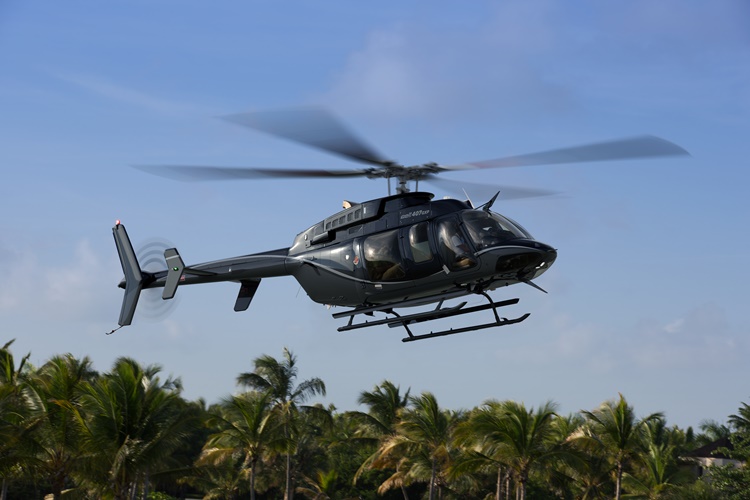
Beyond the quarterly delivery numbers, Bell saw its commercial order pipeline grow during the quarter. Life Flight Network, the largest not-for-profit air medical programme in the US, which currently operates 35 Bell aircraft, placed an order for three additional Bell 407s.
The quarter also saw Bell 505 exceed 700-deliveries.
Moreover, Bell said it is backing its commercial momentum with targeted factory investment. Capital expenditure at Bell’s drive system centre and rotors facility began during the quarter, aimed at increasing capacity and throughput while reducing labour reliance.
The company has also deployed a new AI-enabled shop floor scheduling tool, developed internally at Bell’s manufacturing technology centre.
The biggest challenge to increasing output is the supply chain, said the company. Of particular concern is securing critical raw materials used in gearbox and rotor blade manufacturing, including gear steel, castings and extrusions.
Bell expects a strong second half for its commercial helicopter business, it said.