HI Uplift: 2026 proving ‘best helicopter year since Covid’ but …
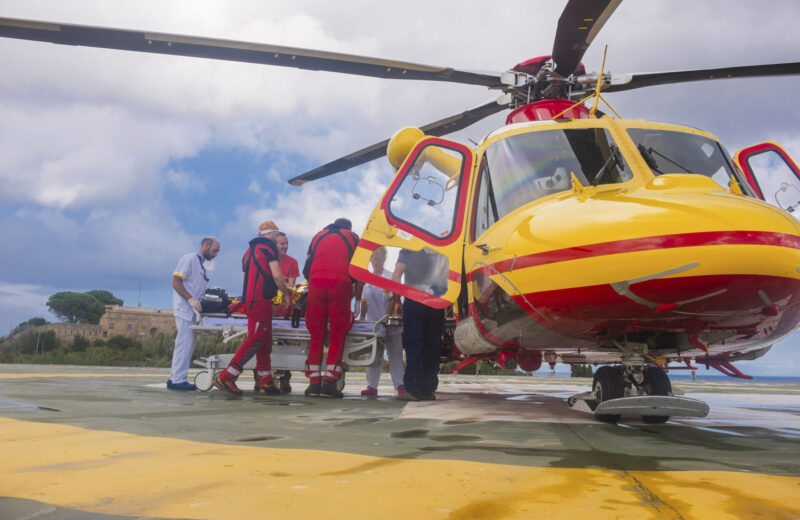
No more surprises in the No Surprises Act is fuelling growth in the US air ambulance sector. (Photocredit: Shutterstock).
This year is proving to be the best for the civil helicopter industry since the Covid outbreak of 2019 – despite the long shadow of supply chain challenges, according to Brad Shaen, director and founder of International Aviation Marketing.
“We haven’t seen it like this since pre-Covid levels and pre-2015 when we were in the oil and gas crisis,” Shaen tells us. “It’s very good right now – things are getting progressively better with the rate of improvement depending on what aspect of the industry you’re looking at.” Sadly, that sunny outlook does not extend to the supply of helicopter parts, he adds.
But let’s start with the sunny uplands. Shaen detects growth in all the key sectors of helicopter emergency medical services, oil and gas and firefighting – although the pace of that growth depends on individual markets.
‘Growing globally’
Emergency medical service (EMS) is one of the biggest growth areas. Shaen highlights rising orders and deliveries to EMS operators not solely in North America but, increasingly, worldwide. “The EMS sector is growing globally – with a lot of infrastructure development around the world and Third World countries adding to demand,” he says. Plus, this demand is built on market growth not simply fleet replacement.
One reason for US growth is that operators have come to terms with recent legislation, such as the No Surprises Act, which had stalled the market. This act had driven some operators to seek Chapter 11 protection – notably Air Methods in 2023. Also, the acquisition of helicopters not only improves patient services and outcomes, it’s also good for “the hospitals’ marketing in spreading the word about services”, says Shaen.
While demand in the oil and gas sector (by far the largest sector) remains strong – the pace of growth appears to have slowed a little, according to Shaen. The North Sea remains important, but exploration and production of oil and gas is stepping up in Brazil, the Gulf of Mexico and West Africa. “If you look at Bristow, PHI and the regional operators, they are all doing well – they continue to grow and prosper,” says Shaen.
Continue climbing
Beyond the short term, with global conflict continuing to fuel short-term prices, long-term demand for oil and gas is predicted to continue climbing. Recent research by Westwood Global Energy Group forecasts global demand for oil and gas is expected to climb by 12.4% over the next 15 years. Demand for oil is expected to show 9% growth in the years from 2025 to 2040 reaching about 115 million barrels of oil equivalent per day. Over the same period, demand for gas is predicted to rise by 17.5%.
Government service and parapublic contracts is another area of sustained growth. Earlier this year, Bristow identified this area as one of three key “mega trends” driving demand for its services in the form of offshore search and rescue contracts for the Irish and British governments. (In June, Bristow expanded its government services business with the acquisition of Berry Aviation from Acorn Capital Management for $105m in an all-cash transaction).
Firefighting missions also continue to rise worldwide. As global temperatures continue to climb relentlessly, so does demand for rotary lift to fight the fires they cause. What used to be discrete fire seasons seem to be merging into one omni season requiring the transport of assets around the globe depending on the time of year and the nature of the threat. North America, Europe and Australia remain areas of particularly intense demand.
‘Lack of inventory’
“Right now, we have a really good balance of supply and demand,” says Shaen. “But there is a continuing lack of inventory out there. People are definitely holding onto their assets – leases are becoming extended,” he says.
Against this background of rising demand and limited helicopter supply, Shaen also warns against a return to the bad old days of 2015. High oil prices sparked rising aircraft production that was, ultimately, unsupported by demand leading to a prolonged downturn. “If we go to a point where there’s abundance of aircraft again [not matched by demand for lift], there are no positive impacts for the business. We would again continue to struggle with an excess of aircraft that just aren’t needed.”
After seeing a little sun, let’s explore more of the dark side with a look at the state of the supply chain for civil helicopter parts. Shaen’s assessment is frank: “From a parts supply standpoint, it is far worse than it’s ever been,” he tells us.
Despite talk of gradually improving supply chains, Shaen has seen little let up in the scramble for key helicopter parts that keeps some aircraft grounded and some operators facing penalty clauses for the reduced or non-availability of aircraft. In particularly short supply are windscreens and air conditioning units along with engine parts. The parts supply problem, exacerbated by delays in supplying new aircraft is making operators extend the life (and leases) of their existing fleet, he says. “So, if new aircraft are difficult to source and parts difficult to find, operators tend to keep their aircraft for longer.”
Troubled supply chain
Support for Shaen’s claims of a troubled supply chain is not difficult to find. Earlier this month, Chris Bradshaw, CEO and president, Bristow Group warned: “Persistent industry supply chain challenges have hampered our performance.” He added ruefully: “The fact that this is a familiar theme common across the aviation sector does not make it any less frustrating.”
Meanwhile, Shaen sees no easy solution to industry-wide supply chain woes. (But he does give credit to Sikorsky for resolving its S-92 gearbox problems). “It’s a never-ending battle – there always seems to be a shortage of some part plus scarcity of materials.” One solution would be for manufacturers to design products that they can easily support and source, he suggests.
Helicopter Investor News
GDHF delivers two leased Airbus H160s to Skyjets in India
THC signs for up to 60 Bombardier business jets
ACH reveals new Line interior for ACH130 fleet
Bell and Semper Fly open Bell 206 Oklahoma training hub
Sikorsky sells four S-92A+s for presidential flights
HI Uplift: ACH boss talks new heli models and superyachts
HI Uplift Dashboard: Helicopters for sale
Multi engines
Total for sale/lease: 230 – three more than last week
Percentage for sale/lease: 2.23%
Absorption rate: 3.92 months
Total fleet: 10,332 – three fewer than last week.
Single engine
Total for sale/lease: 412 – one fewer than last week
Percentage for sale/lease: 3.01%
Absorption rate: 4.28 months
Total fleet: 13,687 – one more than last week.