DRF Luftrettung logs 36,407 ambulance missions in 2025 – up 1.6%
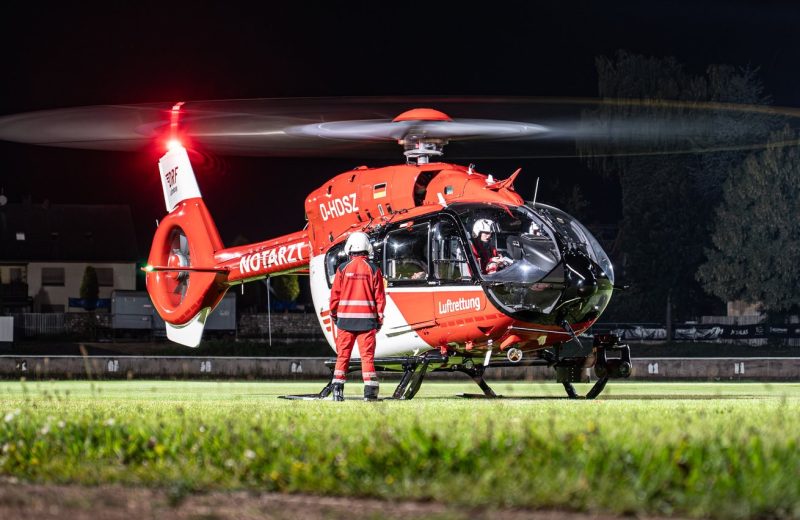
Night move: Missions after dark are becoming more important for helis like this H145. (Source: DRF Air Ambulance).
The German air rescue group DRF Luftrettung has confirmed its helicopter and fixed-wing fleet logged 36,407 missions last year – a rise of 1.6% compared with 2024. It also reported a big increase in the frequency of night call out for its aircraft.
Continuing previous trends, medical emergencies involving cardiovascular diseases, such as heart attacks or strokes were the most frequent reasons for helicopter emergency calls. The red and white air rescue helicopters also responded often to accidents and falls, according to the non-profit air rescue organisation’s annual report. Rescue winches were used 226 times to provide emergency medical care and airlift patients – a rise of 41% compared to the previous year.
Based at Karlsruhe/Baden-Baden Airport, the team at DRF Assistance carried out 479 medically escorted patient repatriations worldwide with its three air ambulances – 24% on 2024. The crews flew to a total of 45 countries, flying about 1.6 million kms – the equivalent of 40 trips around the Earth.
Last year, 13 DRF Luftrettung stations were ready for 24/7 deployment around the clock. One quarter of their missions were carried out at night. Night time air rescue services should be more widely available, says the organisation.
“This is one of the key demands we are emphatically making to policymakers,” said Dr Krystian Pracz, CEO of DRF Luftrettung. “Comprehensive and nationwide emergency care must not depend on the time of day,” he added. “Technically, we are already capable of flying after sunset at all our locations. We therefore call for a needs-based expansion that accommodates social life – meaning both the extension of operating hours and 24-hour air rescue services. Emergencies don’t adhere to a schedule.”
The best patient care requires the best equipment, said DRF Luftrettung. “Thanks to the continuous modernisation of its helicopter fleet, the non-profit air rescue organisation is constantly operating state-of-the-art helicopters of the latest generation,” it said in a statement accompanying its annual report. “With H145 and H135 helicopters, the non-profit organization operates the most modern fleet of any air rescue organisation in Europe.”
The H145 is suited for a wide range of dual-use operations: from emergency missions to complex intensive care transfers between hospitals, claimed the organisation. Its high payload capacity and a third seat in the cabin are said to offer extensive operational possibilities. For example, a paediatric team can accompany the transport of a child, or heavy medical equipment can be carried for particularly complex medical missions, claimed DRF Luftrettung. “The crew can also refuel with more kerosene, allowing them to fly longer distances without refuelling, saving valuable time for patients. The helicopter’s increased performance also opens up more possibilities for high-altitude missions, such as in the Alps. Furthermore, the new rotor system provides even smoother flight, benefiting both patients and crew.”
The H135 and H145 helicopters are equipped with features including a Helionix cockpit: a digital cockpit designed to assist the pilot in optimising flight operations and so increasing safety. Combined with a four-axis autopilot, an anti-collision system, weather radar, high-performance searchlights, and state-of-the-art medical technology, the aircraft are “ideally equipped” for complex air rescue missions, both day and night, said DRF.
Meanwhile, DRF Luftrettung and Airbus Helicopters signed the purchase agreement for 10 H140 helicopters in July 2025. “With this step, DRF Luftrettung continues its tradition as a launch customer for new, innovative helicopter models,” it said.