HI Uplift: Airbus highlights role of multi-mission helis
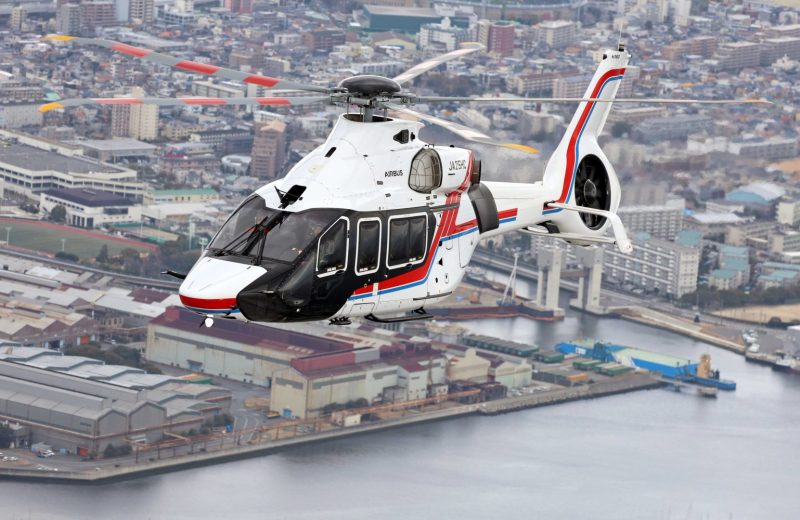
Hiroshima City Fire Services took delivery of its first Airbus H160 last October.
Airbus Helicopters revealed a big order for multi-mission rotorcraft from Ghana’s Ministry of Defence earlier this year. The contract, the first with the African nation, includes two H175Ms, which will be deployed on transport, search and rescue, emergency medical services and disaster relief missions. Plus, one ACH175 and one ACH160 operated for transport flights. The key words here are multi mission.
It’s yet more evidence of the convergence between some civilian and military missions. Not least search and rescue, offshore operations, medical evacuations and transporting people and cargo. So, with shared mission profiles, plus cost and supply chain pressures, it makes sense to build multi-use platforms. But platforms still require a high level of customisation for specific missions such as helicopter emergency medical services (HEMS).
Regis Magnac, vice president and head of Energy, Leasing and Global Accounts explains the significance of multi-mission helicopters. “Civilian and military helicopters are very different types of market,” Magnac tells us. “But dual-use assets are important – it’s key to the basic economics of it [modern helicopter production].”
‘Multi-mission work horse’
He cites the example of the Airbus H125. Described by the manufacturer as “a multi-mission workhorse”, the single-engine helicopter, part of the Ecureuil range, can carry up to six passengers with one pilot at a fast cruise of 136kts over a range of 340nm.
“In addition to bespoke helicopters that have been designed for special needs, Airbus produces [versatile] platforms like the H125, for example,” he says. “It’s a powerful and very reliable platform and the economics make it very successful. It’s an excellent baseline when you have those three factors to make it a military platform or for civilian use.”
Equally at home wearing military or civilian paint schemes, civil and parapublic missions for the H125 include: air ambulance, SAR, police and law enforcement and firefight operations in addition to utility and industrial work together with other missions. Wearing camo colours, typical flights include aerial observation and patrol, border surveillance, intelligence gather and training flights.
Multi-use helicopter platforms are an attractive proposition at a time when rotary design, development and production costs are under increasing scrutiny. “It’s very important because [when we have a basic platform], we’re avoiding all the investments, what we call the non-recurring costs, into different products,” says Magnac. “We can share the investment costs into different markets, not just one. So, dual products are a way of taking the benefit of a good product for both markets and creating a bigger market for that product.”
Firefighting helicopters
For Airbus, the civilian market is divided across multiple segments and niches. For example, firefighting helicopters are regarded by the manufacturer as being in the utility category because they fly other missions outside the fire season. Other categories include offshore and corporate transport.
Commenting on the Ghana government’s ACH160 order for corporate transport, Arnaud Montalvo, head of Africa and Middle East Region for Airbus Helicopters said: “This key deal also makes Ghana a leading customer in West Africa for our premium corporate helicopters, the ACH160 and ACH175.”
The medium category ACH160 is the latest member of the ACH family and is the world’s most technologically advanced helicopter, with 68 new Airbus patented technologies, according to Montalvo. “It provides 20% greater volume per passenger compared to previous generation medium twin helicopters and 35% larger windows than its competitors, resulting in the brightest cabin in its class,” he added.
Magnac tells us that the H160 delivers much needed choice to the market. “The H160 has been successful quickly because of its advanced technology and because it delivers choice – the AW139 has been alone in the market for a long time,” he tells. “There’s a need for diversification, diversity, choice. Choice is good. And then the medium segment is a large segment in reality between former S76 market, former Bell 412 market and the former AS365 Dauphin helicopter market. We’re happy that there’s anyway a lot of room on the market for this segment.”
‘Commercial momentum’
Moving on to the heavier metal in the helicopter market, Magnac acknowledged Sikorsky had invested in a new gearbox for its S-92 workhorse. But he added: “While the S-92 has been a long-standing fixture, the market is evolving. Today, the H225 is the heavy platform seeing the most active development and renewed commercial momentum.”
Turning to the super-medium market, he highlighted the aircraft type’s performance and cost advantages over the heavies. Compared with heavy helicopters super-mediums, such as the Airbus ACH175 sold to Ghana, incorporate new technologies delivered at lower cost. “They [super-mediums] deliver an equilibrium of performance and price. It’s a machine that transports, basically does 90% of the missions for 30-35% less cost. So, it’s a good mix,” said Magnac.
According to the manufacturer, the H175’s long range and payload with smooth flight qualities make it the optimal solution for a wide range of onshore and offshore mission profiles, including disaster relief, search and rescue, public services and a wide range of military missions, as well as crew change and private and business aviation.
So, multi-mission helicopter design looks here to stay. With the cost and manufacturing advantages on offer from multi-mission designs, helicopters wearing both civilian colours and military camouflage won’t be disappearing any time soon.
HI Uplift Dashboard: Helicopters for sale
Multi engine
- Total for sale/lease: 250 – two fewer than last week
- Percentage for sale/lease: 3.26%
- Absorption rate: 3.32 months
- Total fleet: 7,675 – two more than last week.
Single engine
- Total for sale/lease: 412 – seven fewer than last week
- Percentage for sale/lease: 3.52%
- Absorption rate: 3.68 months
- Total fleet: 11,708 – two fewer than last week.
Source: AMSTAT, February 27th, 2026
Helicopter Investor News
- Leonardo posts 2025 revenue 11% up at €19.5bn
- Bristow posts 2025 revenue up at $1.5bn
- Bumper Q4 for rotorcraft deliveries reports GAMA
- Heli hires: Bristow appoints new chief legal officer
- HI Deal of the Year Awards 2026: Nominations welcome
- HI Uplift: Airbus screens full-year 2025 results