HI Uplift: Michael York, GDHF – ‘Helicopters still perform the magic’
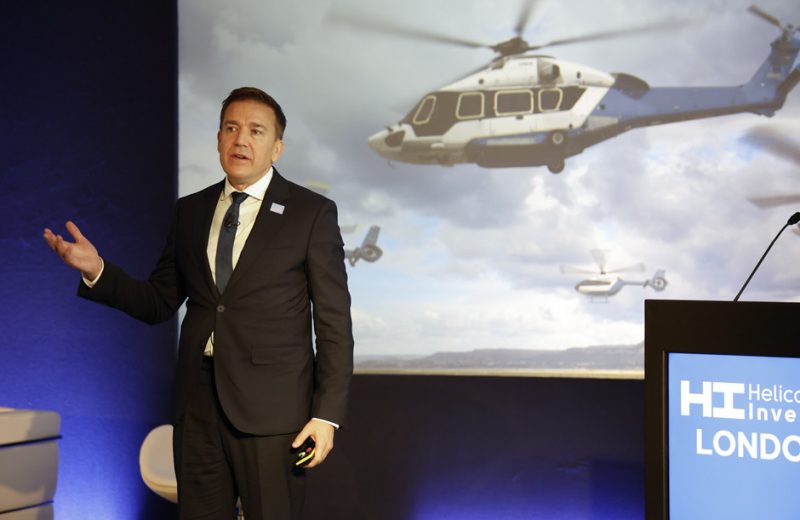
Michael York, CEO, GDHF and former teenage Huey aircrew.
Michael York was a 17-year-old midshipman when he first flew in the back of a Royal Australian Navy Bell UH-1B Iroquois – better known as the Huey. More than three decades later, having piloted military Squirrel and Seahawk helicopters and then multiple fighter jets in locations around the world, he is now at the helm of lessor GDHF Helicopter Finance. York remains full of boundless enthusiasm for what helicopters can accomplish. And what the industry can achieve in its newly stable market.
“I’ll never forget the magical experience of taking off vertically – it was astonishing,” he told the first day of our Helicopter Investor London 2026 conference. “I also don’t forget the absolute obsolete nature of the avionics. Steam-driven gauges and Chinagraph pencils writing on the windscreen.”
It’s a memory charged with significance for the executive who launched lessor GDHF in April 2024. Since then, York and his growing team have focused their portfolio on new-technology medium and super medium twin-engine helicopters, rather than maintaining a mix of legacy aircraft.
GDHF has an order book of 50 Airbus H160 medium helicopters. Of those, 10 assets have already delivered to clients in Brazil, Europe, India and elsewhere.
£200m order book
It has also secured up to 20 super medium Airbus H175s, mainly for the markets of offshore energy, search and rescue and emergency medical services, with one delivered so far. Plus, the lessor has commitments for 13 AW189s with three delivered to offshore operator Omni Helicopters in Brazil. Overall, the lessor has invested more than £200m in its order books and, since launch, has purchased 26 aircraft in as many months.
“Fleet modernisation and the magic of helicopters has been in my head for a long time, and we all work together to create the magic,” he said. “We’re trying to fulfil operator and end-user needs and fulfil replacement Helicopter demand with new technology multi-mission assets. We’ve taken a big bet on that.”
A big bet but one made in a relatively stable market. Despite war in the Gulf, mission-critical helicopters continue to fly. “They’re still performing the magic.” But he did acknowledge a short period when the Gulf helicopter fleets were not flying – when 20% of global oil and gas production was shut causing an enormous and unprecedented reduction in supply.
But despite wars and rising geo-political tensions, the civil helicopter industry is in good shape compared with the difficult times of recent downturns. “It’s actually very nice to be in the boring, steady growth market that has a large need for fleet replacement. And long may it continue,” said York.
Tightly-balanced markets
The industry was not experiencing “explosive growth” but rather tightly-balanced markets. Supply chain challenges and military demand were combining to limit the output of new super medium helicopters, said the CEO of GDHF.
York also welcomed the trend towards increasing prices and margins for helicopter operators after several years of delivering helicopter services below cost. “Offshore is good, and coming back,” he said. “That’s a meaningful part of our business model, and it’s a meaningful part of the demand story for the segments in which we operate.”
More generally, he welcomed steady growth in maturing markets. This was attracting greater financial interest and more players from top-tier banks, from alternate financiers and from new private equity providers entering the market. Healthy signs in the market were consolidation, mergers and acquisition, portfolio sales and a liquid secondary market of on-lease assets, he said.
Another industry trend is fleet modernisation as older platforms reach the end of their primary working lives, he noted. “There is an enormous fleet out there that needs replacing over time. And the beauty of technology is that while the introduction is often incremental and slow, every generation [of new equipment] is safer, more efficient, more capable. But it’s not gradual. Fleet replacement is not exactly linear and mechanical – it’s lumpy.”
‘Proven super mediums’
New technology that is needed, in part, to replace the S-92 – “the core of the long-range offshore fleet” – with more helicopters reaching 20 years of age. While still a high-yielding and very capable aircraft, “It has already started retiring out.” Some have been parted out, some have hit age limits and some have been repurposed in other missions. “That’s our core thesis there. The good news is we have the proven super medium replacements,” said York.
More than 50 super mediums of each type are already in service – with some operating for nearly a decade. “So, we have mature products and we should feel good about this. The future of the long-range offshore Helicopter fleet is assured,” he added.
His confidence lies in the fact that two leading manufacturers (Airbus and Leonardo Helicopters) are upgrading and supporting their super medium platforms. Plus, from a lessor’s perspective, super mediums tick all the right boxes, he said. Those include meeting underlying demand, multi-mission capability with quick change configurations, cost-effective operations and globally mobile availability.
Turning to audience questions, the first touched a topic notably absent from the CEO’s presentation: GDHF’s proposed acquisition of offshore helicopter operator NHV. While bound by non-disclosure agreements and contractual confidentiality provisions, York did concede: “We signed a Sale & Purchase agreement in December and we’re working through a regulatory process.”
‘Stays in their own swimming lane’
Another questioner tried a different tack asking for York’s thoughts about an (unnamed) lessor owning an (identified) operator? York said it had been done before. “You just keep the two businesses separate. If you keep things completely separate, everyone stays in their own swimming lane and it works – people in the industry understand the differentiation.”
A final questioner probed the CEO’s views on the development of civil helicopter market in China. He judged it a market with “enormous long-term potential upside”. In China there is a fleet of about 1400 civil helicopters serving a population of 1.4bn people, he said to illustrate the size of that potential. That compares with Australia which has 1,100 rotorcraft and a population of 28 million people.
“China’s Airline travel market is already number 2 in the world, growing fast and may eventually be the world’s biggest commercial aviation airline travel market, bigger than America. If we apply that logic to helicopters, China could theoretically grow to 10,000 helicopters, but it doesn’t have anything near that number of Helicopters now.” However, he acknowledged the impediments to China’s helicopter industry growth included: cultural obstacles and infrastructure barriers, military control of airspace and a host of other factors.
At least the country is scheduled to have two more Airbus H160 helicopters, after GDHF revealed a deal to supply an unnamed customer in the vast nation a few days before our conference. It’s an aircraft that is a world away from the venerable Huey in which he climbed vertically all those years ago. The H160 claims a speed of 150Kts, 480nm range and 18% less fuel consumption than the previous class of similar helicopter and 15% lower maintenance costs.
Recalling his first flight in the iconic Huey, York said: “My arrogant 17-year-old self at the time thought it was ancient, because it was 20 years old, Vietnam War-era technology.” What would his younger self have made of the latest next generation technology featured in GDHF’s order book of H160s, H175s and AW189s?
HI Uplift Dashboard: Helicopters for sale
- Total for sale/lease: 239 – two fewer than last week
- Percentage for sale/lease: 2.3%
- Absorption rate: 3.19 months
- Total fleet: 10,397 – one more than last week.
Single engine
- Total for sale/lease: 411 – one more than last week
- Percentage for sale/lease: 3%
- Absorption rate: 3.96 months
- Total fleet: 13,699.
- Source: AMSTAT, July 3rd, 2026