HI Uplift: Bristow hails ‘best industry conditions in 12-plus years’
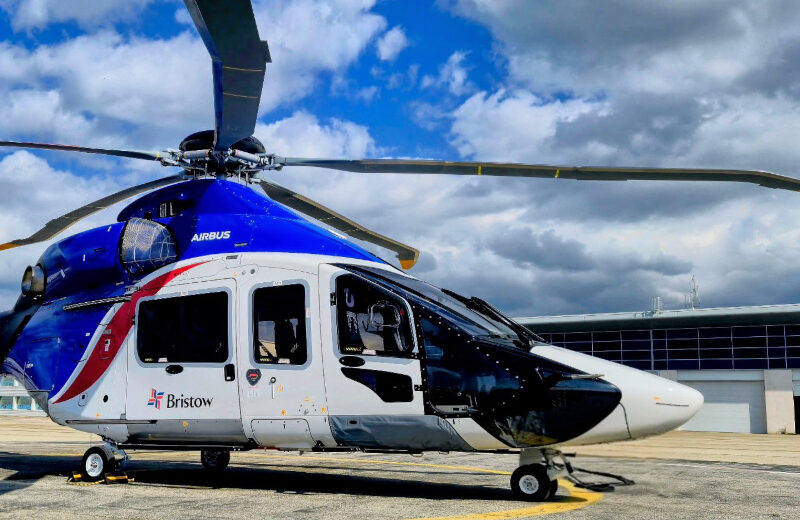
Bristow has16 active Airbus H160s in its offshore fleet – with a utilisation rate of 94%.
Bristow Group president and CEO Chris Bradshaw was in buoyant mood as he closed the operator’s third-quarter earnings call this week. Positive offshore energy fundamentals and the tight supply of offshore helicopters are combining to yield “more favourable industry conditions than we’ve seen for more than a dozen years,” he said. Just don’t ask about sourcing helicopter windscreens.
Underpinning Bradshaw’s optimism was a strong third-quarter performance – albeit marred by continuing supply challenges – coupled with rosy predictions for long-term oil and gas demand and final investment decisions. Bristow Group posted third-quarter revenue of $437.9m – an increase of 6.4% or $26.2m on the $411.8m achieved in the second quarter.
The biggest single contributor was the July acquisition of government special mission business Berry Aviation – now rebranded Bristow Special Mission (BSM). This yielded $16.9m to the operator’s Government Services business and $9.2m to Other Services in the third quarter. Higher utilisation in the Americas and Australia added to the quarter, partly offset by lower utilisation in Europe. Government Services revenue rose $17.8m from the second quarter to $130m.
Americas climbed $6m
Offshore Energy Services, the biggest part of Bristow’s business, saw revenue fall by $5.6m from the second quarter to $256m. Europe fell by $10.9m compared with the second quarter reflecting lower utilisation. Africa dropped $0.7m from the second quarter after supply chain-linked higher penalties. The Americas climbed $6m on the second quarter reflecting higher utilisation and rates.
Adjusted EBITDA was about $10m higher at $90m. Net income reached $27.7m ($0.93 per diluted share) compared with $21.2m in the previous quarter. The business affirmed 2026 adjusted EBITDA at the midpoint of its financial year.
So much for the here and now. Longer-term predictions sparked considerable optimism. Despite the (temporary) fall in Offshore Energy Services revenue, Bristow remained buoyant about the strong fundamentals for revenue growth. For evidence, it cited research revealing robust growth in oil and gas demand and offshore spending at a time of tight offshore helicopter capacity.
Starting with demand, Bradshaw pointed to research by Westwood Global Energy Group forecasting that global demand for oil and gas is expected to climb by 12.4% over the next 15 years. Demand for oil is expected to show 9% growth in the years from 2025 to 2040 reaching about 115 million barrels of oil equivalent per day. Over the same period, demand for gas is predicted to rise by 17.5%.
Final investment decisions
Adding to the optimism, offshore project final investment decisions (FIDs) are on track to exceed $110bn this year – which would be 61% up on the about $70bn achieved last year, according to Wood Mackenzie research. The outlook for next year is another 30% increase to total FIDs of about $144bn in 2027.
Deepwater offshore (floater) rigs now number 121 – up from 116 in the fourth quarter of last year. The total is expected to rise to 124 this year, 131 at the end of next year and 138 by the close of 2028.
Geopolitical turmoil has re-focused attention on energy security, said the Westwood researchers. This is expected to drive a 22% increase in offshore oil and gas spending this year compared with last year.
All this comes at a time when civil helicopter capacity – constrained by continuing supply chain challenges and rising military demand for airframes – remains (and is likely to remain) tight. The Bristow CEO highlighted research on the utilisation rates of global heavy and medium offshore helicopters, conducted last month by Steve Robertson, director, Air & Sea Analytics.
Robertson charted a global offshore fleet of 160 Sikorsky S-92 helicopters with an effective utilisation rate of 99%. The fleet of 43 AW189s achieved 100% utilisation while the AW139 fleet of 302 helicopters was at 91% utilisation. The utilisation rate of 50 offshore H175 helicopters was 96%.
Bristow ended the quarter with 195 helicopters, 36 fixed-wing and three unmanned systems with a total of 234 aircraft. (This excludes UAS platforms developed, designed or produced by BSM).
Sourcing windscreens
Returning to the supply chain difficulties marring Bristow’s sunny skies, we were unfair to suggest Bradshaw did not want to talk about supply chain challengers – including sourcing windscreens. (Contrary to popular belief, the chief ingredient in their manufacture is not ground-up unicorn horns).
He was frank both about the scale of supply chain disruption and their consequences together with the mitigations manufacturers are putting in place. “Persistent industry supply chain challenges have hampered our performance,” said Bradshaw. “The fact that this is a familiar theme common across the aviation sector does not make it any less frustrating.”
To illustrate the scale of the problem, on-time deliveries from key original equipment manufacturers since 2020 have dropped by about 20%, according to the operator. Missed delivery dates have slipped by extended intervals.
Bristow has boosted inventory levels and taken other measures to combat supply chain woes, said Bradshaw. “Unfortunately, key components continue to have increased turn times and arrive late from the suppliers,” he added. “While we are experiencing these challenges across Bristol’s business, the most acute impacts can be seen in delayed aircraft modification programmes for the company’s new search and rescue contracts.”
‘Lost revenue opportunities’
The delays and knock-on effects are continuing to depress margins in Bristow’s government services segment, he added. The damage manifests not simply in the form of contractual performance penalties.
“They include, but are not limited to, lost revenue opportunities, manpower and time spent chasing parts, cannibalisation of the company’s internal fleet to keep aircraft flying and delayed aircraft lease returns, not to mention retaining additional headcount, overtime expense, and costs for outsourced third-party maintenance support.”
The problem is not so much the delivery of new aircraft, it is the aftermarket and the availability of parts for existing aircraft. Sourcing helicopter windscreens has been particularly frustrating. “The industry has been too concentrated in a single-source supplier and they have issues, both from timing and quality control,” said Bradshaw.
To help resolve these problems, Leonardo – which supplies assets for Bristow’s SAR programmes in Europe – has invested in two other windscreen suppliers “to help provide the better resiliency into that key component”. All the new aircraft going to work on the Irish Coast Guard contract are AW189 super medium helicopters. Plus, most of the aircraft fro the UKSR 2G SAR contract are AW189s and to a lesser extent 139s.
Maintaining the positive theme, Bradshaw believes the supply chain picture will stabilise next year. “Overall, we think the incentives are in place to get this fixed.”
Helicopter Investor News
Milestone signs six-heli leasing deal with Omni
Raymond James keeps ‘Outperform’ rating on Bristow
Bristow’s Berry acquisition lifts Q3 revenue
ifly joins Leonardo’s AW139 authorised service centres
Peter Jiang to lead GDHF as CEO Michael York quits
Airbus Helicopters profit falls 10% in first nine months
HI Uplift Dashboard: Helicopters for sale
Multi engines
Total for sale/lease: 231 – three more than last week
Percentage for sale/lease: 2.24%
Absorption rate: 4.03 months
Total fleet: 10,332 – two more than last week.
Single engine
Total for sale/lease: 421 – the same as last week
Percentage for sale/lease: 3.08%
Absorption rate: 4.41 months
Total fleet: 13,684 – two more than last week.
Source: AMSTAT, November 6th, 2026