HI Uplift: Bristow predicts megatrends to spark new govt contracts
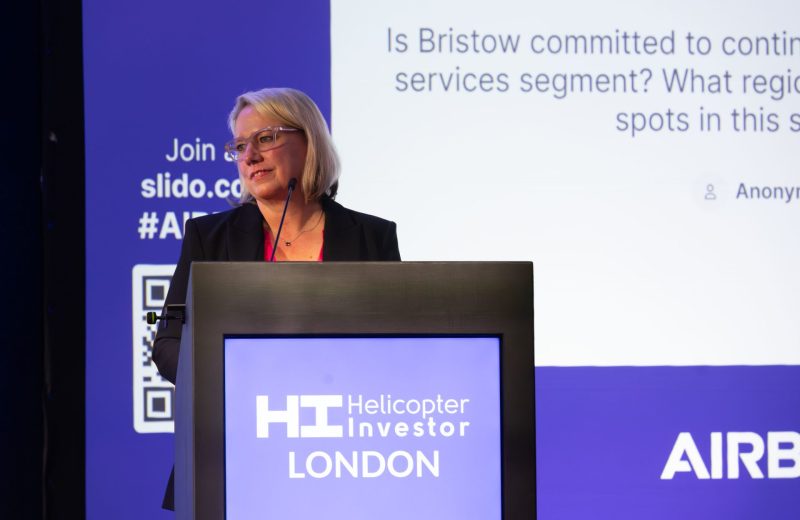
BristowCFO Jennifer Whalen
Bristow Group forecasts increased defence expenditure – one of the three megatrends it says are shaping the helicopter industry – will lead to more government contracts. The flight path to potential profit was set out by Jennifer Whalen, senior vice president and chief financial officer, Bristow Group at our Helicopter Investor conference last month.
The trend is likely to lead to the greater outsourcing of government services such as search and rescue (SAR), according to the operator. The two other trends Bristow thinks will help grow its business are the prioritisation of energy security and the electrification of transportation.
The operator has already won major SAR contracts from the UK government and the Republic of Ireland. It’s a trend that will be repeated elsewhere in Europe as countries look to balance their budgets in the face of more investment in military hardware, Bristow hopes.
“European countries have made some pretty big commitments to NATO, which has spurred a lot of activity [aimed at cutting costs],” Whalen told our conference. “We have had inbounds [contacts] from several different countries around being able to commercialise their search and rescue services. They’ve seen what’s happened in the UK and Ireland and other countries. It’s an easier way to offload the need for capital expenditures.”
Fleet of 216 aircraft
The operator certainly has the airborne assets to service more government contracts and support for the offshore oil and gas industry. Bristow operates a fleet of 216 aircraft, of which about 200 are helicopters. “We’ve got a fleet of planes for a small airline that we have in Australia that makes up the difference. The most relevant aircraft here are the S-92, the AW189 and AW139,” says Whalen. In March, the operator also took delivery of two Airbus H160 medium helicopters, leased from Milestone, for deployment in the Nigerian oil and gas industry. A further three H160s will follow.
Bristow’s search for government contracts stems from about 2020 when it merged with the Era Group. In a bid to diversify its revenue streams away from supporting the oil and gas industry, the operator spent a few years bidding on new contracts that were already in the civilian commercial market. “We did win pretty much every major government SAR contract that’s come up in the past few years,” said Whalen.
Revealing the scale of the investment cycle, Whalen added: “We spent $300m in the past couple of years putting helicopters into place for these. But they are 10-year contracts that have very nice cash flows, nice returns.”
It was those steady revenues that the chief financial officer credits with enabling Bristow to pay its first dividend since combining with the Era Group. “It was really based on these cash flows. If we were [solely] an oil and gas company, we wouldn’t have been talking about issuing a dividend, but because we have these very stable cash flows, we’re able to do that.”
‘Increase defence spending’
Further evidence of the financial potential of government services comes from Christopher Bradshaw, president, CEO and director of Bristow. “We’re seeing a lot of conversations – particularly out of Europe right now – as those countries have committed to increase their defence spending, usually tied to percentages of GDP,” he said in May.
“They’re looking for ways to balance their overall budgets. One of the ways they could do that, as they’re spending more money on tanks and missiles, is potentially outsourcing some of the civilian services like the coast guards. So, we’re having conversations with more countries, again, particularly in Europe about potentially outsourcing their civilian services, which could be a source of growth for our core search and rescue business.”
Government contracts are not confined to Europe. A rise in US defence spending has also created opportunities in aviation – rotary wing as well as fixed wing and drones – for military contracts flying missions such as aerial surveillance. “The US has a huge market in outsourced aviation services. Many companies, particularly smaller aviation companies, do ISAR- [International Search and Rescue] type work, intelligence, surveillance, reconnaissance work and MRO [maintenance, repair and overhaul] work.” But the US Coast Guard is unlikely to relinquish its SAR responsibilities, noted Whalen.
‘Search and rescue teams’
Returning to MRO services, Bristow expects fresh opportunities in Europe. “Because of the large commitments [European governments] have had to make to NATO, they’re likely going to need public-private partnerships with companies,” the CFO explained. “That could include doing MRO, helping with asset acquisition, training pilots. Bristow has done some pilot training for some different governments in Europe over the past several years. Those are capital-light – we can use the aircraft that we already have and that may apply with our search and rescue teams.”
Some of Bristow’s competitors already offer MRO services to European governments, she noted. “We think that there will likely be more of that over the next few years as these governments are having to write checks and trying to figure out how to do that and not having the capability to do that internally.”
On ISAR missions, Bristow already does some ISAR work over the English Channel for the UK government related to monitoring immigration. “I think there’s going to be more and more demand for those types of services.”
Energy security is another megatrend that Bristow believes will boost its business. Conflict in the Middle East is leading to “a big focus on energy security”, both in that region and around the world, said Whalen. “I think there will be, for the larger oil companies, probably some additional investment in some of these other areas based on what’s happening … So we have some tailwinds from that. Not only us, but our competitors as well. Increased defence spending should rise all boats.”
‘Shock absorber’
Bristow’s offshore energy business still accounts for about two-thirds of its revenue and the company is still keen to diversify by developing other sources of revenue. Whalen believes diversified revenues will act as a “shock absorber” when the next (inevitable) downturn occurs in the volatile oil and gas industry. It will help Bristow and others avoid “the chaos” that happened 12-or so years ago.
Bristow also identifies the electrification of transportation as a key trend after investing in the sector since 2017. The operator has partnered with eVTOL developers such as Vertical Aerospace, Eve Air Mobility, Electra, BETA Technologies and Elroy Air. (Bristow has agreed to purchase up to 100 VX4 aircraft from Vertical – 50 firm pre-orders plus options for 50 more).
“I think when you talk about defence/government/military, that’s probably going to be adopted earlier than it will in the commercial market, but it may be operated by commercial companies,” said Whalen.
So, while the peace dividend – or the economic benefit a country gets when a conflict ends – may be closing for governments worldwide, those clouds could bring a golden lining for operators like Bristow in the form of new government contracts.
Helicopter Investor News
- Sikorsky starts Firehawk production in Poland
- HI Uplift: India – ‘Equal parts frustration and admiration’
- Avincis wins contract to continue HEMS in Sweden
- US border control agency orders 10 Airbus H125s
- Bristow agrees to pick Berry Aviation up for $105m
HI Uplift Dashboard: Helicopters for sale
Multi engines
Total for sale/lease: 237 – one more than last week
Percentage for sale/lease: 2.28%
Absorption rate: 3.19 months
Total fleet: 10,402 – 17 less than last week.
Single engine
Total for sale/lease: 415 – five more than last week
Percentage for sale/lease: 3.03%
Absorption rate: 3.92 months
Total fleet: 13,691 – 13 less than last week.