HI Uplift: VIH’s Fire Raptor planned to prey on wildfires
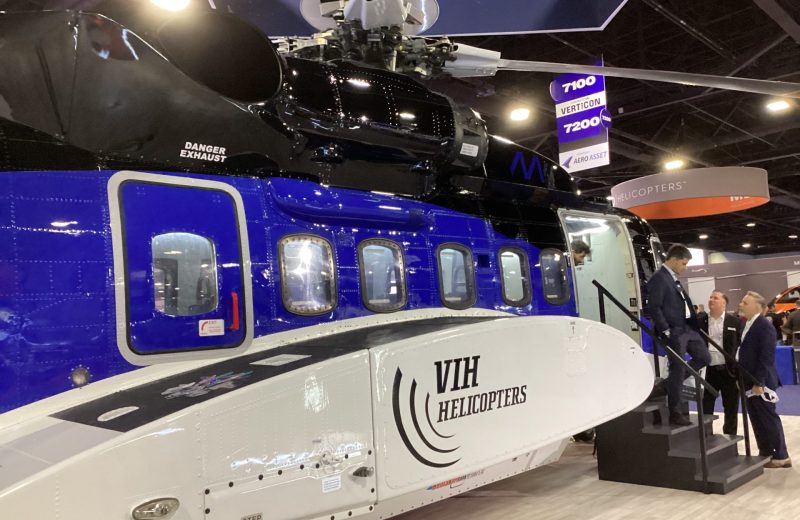
Something old and something new: the oldest S-92 still in commercial service finds a new firefighting role at VIH Helicopters.
It seems a marriage made if not in heaven, then close to it – the skies of Canada’s British Columbia. VIH Helicopters, the oldest privately owned rotary operator in the country, is deploying the world’s first utility configured Sikorsky S-92A specifically designed for wildfire suppression. This is a story of the old and the new – the oldest S-92A – tail number 920006 – still in commercial operation and its new life as a firefighter. Plus, the benefits the new design can bring to its mission and its operator. The helicopter even has an heroic name – the Fire Raptor.
Jen Norie, the company’s chief operating officer and marketing and communications manager for the VIH Aviation Group of companies sees a profitable symmetry in their adoption of the new type.
“We were the Canadian launch customer for the S-92 airframe through Cougar Helicopters, which operates offshore crew transport and SAR missions on Canada’s east coast.
“That gave us the opportunity to see first-hand the aircraft’s exceptional reliability, serviceability and operational capability in one of the most demanding helicopter environments in the world. Over the years, we’ve gained extensive experience with the platform and have been consistently impressed by its performance and dependability,” she tells us.
Front-line deployment
It’s easy to understand the performance statistics that attract VIH Helicopters to the model. Equipped with a 5,000L (1,320gal) Helitak carbon fibre retractable belly tank, the helicopter can fly for more than four hours on extended fire suppression missions. It can also seat up to 19 firefighters for rapid front-line deployment with significant internal and external cargo transport capabilities.
But there’s another figure that captures Norie’s attention – the cost of acquiring the old workhorse.
“As these airframes reach the 20-year point in offshore service, many oil and gas operators begin transitioning to newer airframes despite the helicopters themselves remaining in excellent condition. That creates an opportunity to acquire highly capable, well-maintained airframes at a commercially viable price point.”
Primary life-expired S-92s, with the accumulated flight time of 20-plus-years on their airframe logbooks, can probably be acquired for about $10m, according to the operator. That compares with a new S-92A+ costing between $27.5-$30m depending on specification and a Sikorsky S-70 FireHawk bearing a price tag of around $38m.
Commercially certified
Another factor adding to the S-92’s appeal is that it is one of the only commercially certified new-technology heavy lift helicopters available to government agencies issuing fire suppression contracts. There’s lots of ex-military aircraft available, but they’re not commercially certified, according to VIH.
Norie has a neat solution for reconfiguring older S-92s into their new lives as firefighters. Within the parent organisation is VIH Aerospace – a helicopter maintenance, manufacturing, repair and overhaul centre – in addition to a fixed-wing corporate jet charter business as well as a full-service corporate aircraft terminal at the Victoria International Airport.
“Older S-92 aircraft are brought into our facility and put through a ‘weight loss’ conversion programme, specifically reconfiguring them into Fire Raptor utility aircraft for firefighting,” says Norie. “They remain relatively modern airframes and, once reconfigured, incorporate the updated technology, multiple redundant safety systems and the belly tank installation.”
Over 1,010 firefighting hours
The company deployed its first Fire Raptor – the venerable tail number 920006 (pictured above) – in 2024. Last season it flew about 550 hours and with the addition of another Fire Raptor, VIH logged more than 1,010 firefighting hours. Another Fire Raptor will be added for this season totalling a fleet of three. The first is leased from Milestone, which assisted in developing the Fire Raptor concept, while the other two are owned. They are unlikely to be the last Fire Raptors to join the company’s fleet.
Shane Palmer, director of operations tells us why: “We have always had a wildfire season in Canada but now they are becoming more prevalent. They are starting earlier in the year and lasting longer into the year.”
For example, the company’s original firefighting contract signed with the Province of Alberta seven years ago specified firefighting cover for 100 days from May 1st until August 7th. But last year the fire season extended into September and in 2024 into October. It’s an observation informed by deep personal experience. Palmer joined VIH in 2000 to fly S-61s and Kamov Ka-32 helicopters and has now logged more than 10,000 hours and 30 years of helicopter and fixed-wing flying.
‘Australia and South America’
Plus, the scope for expansion of S-92 Fire Raptor’s missions is not limited to North America. Norie says: “We are very interested in expanding operations into Australia and South America. Because when we finish our [fire suppression] contracts here in Canada, say in September or October, we’re looking for placements for them over the winter months elsewhere.
“Having demonstrated the concept and the aircraft’s capabilities, along with strong interest in the platform here in Canada, we believe it will achieve significant success in international markets as well. As a result, we are also focusing on developing that broader global market.”
Palmer adds: “Yes, there is increasingly a global firefighting requirement. If you combine the Northern Hemisphere and the Southern Hemisphere, we could go back and forth and stay busy fighting fire year-round.”
Growing demand has seen fire suppression evolve from a relatively small part of the business into a significant area of importance for the company. “In the past, we have never really relied on fire contracts or wildfire operations,” says Norie. “They were always considered supplementary work. But over the past 10 years or so, that has changed, and we are now seeing an increasing number of contracts and increasing demand.”
Grow significantly
But fire control missions do not account for the bulk of VIH’s operations. Helicopter logging accounts for about 60% of the company’s business with precision external lift – including aerial construction and power line work – claiming about 5% of all missions. The remainder – about 35% – stems from fire suppression missions. But both Norie and Palmer expect that percentage to grow significantly.
And when it does, there will be no shortage of S-92s to convert into Fire Raptor configuration. Sikorsky estimates that there are more than 260 S-92s still in service with an airframe life-limit of 30,000 hours. If offshore crew transfers account for two-thirds of that total, that still leaves each aircraft with a later working life of 10,000 hours to fill.
Take VIH’s first S-92 as an example. Despite logging over 15,600 flight hours, beginning with supporting oil and gas missions in the Gulf of Mexico, the airframe can look forward to another 14,400 hours of working life. That represents another 28 years if the helicopter continues to log fire suppression missions of about 500 hours a year.
So, it looks as if VIH Helicopters’ partnership with the Fire Raptor will prove long, productive and profitable.
HI Uplift Dashboard: Helicopters for sale
Multi engine
- Total for sale/lease: 245 – one more than last week
- Percentage for sale/lease: 2.36%
- Absorption rate: 3.21 months
- Total fleet: 10,360 – 12 more than last week.
Single engine
- Total for sale/lease: 405 – three fewer than last week
- Percentage for sale/lease: 2.96%
- Absorption rate: 3.62 months
- Total fleet: 13,669 – four more than last week.
Source: AMSTAT, May 22th, 2026
Enjoyed this? Subscribe to our free weekly newsletter focusing on the key helicopter stories in the market.